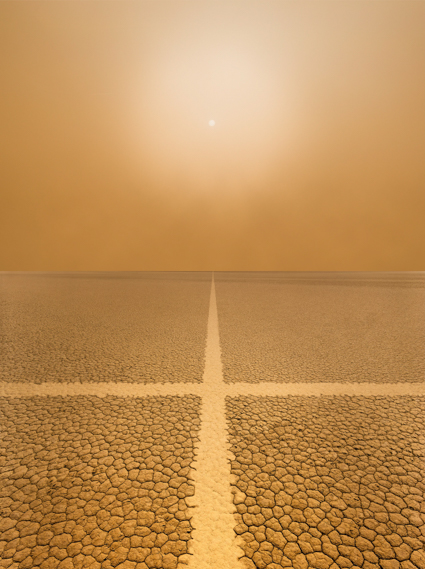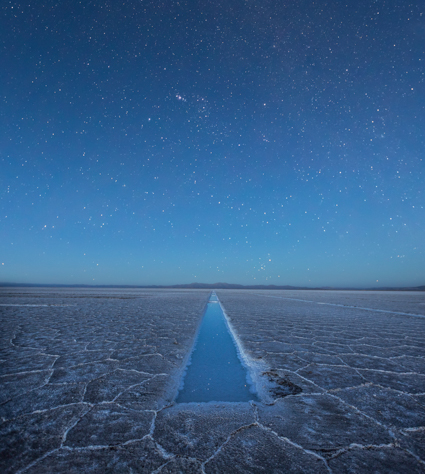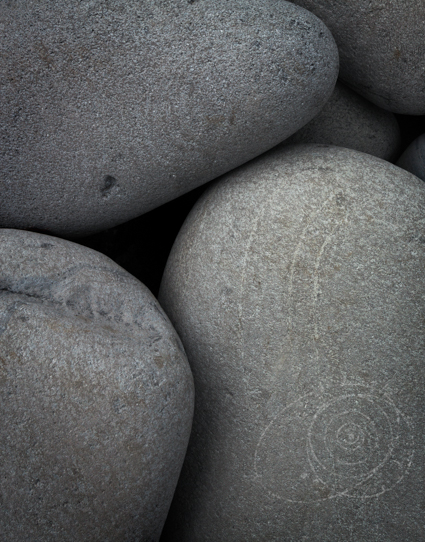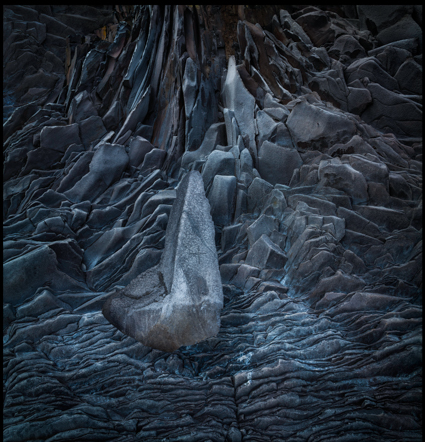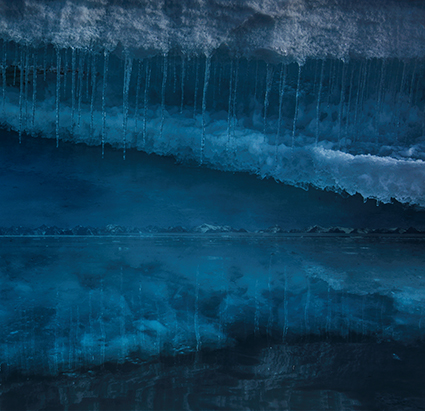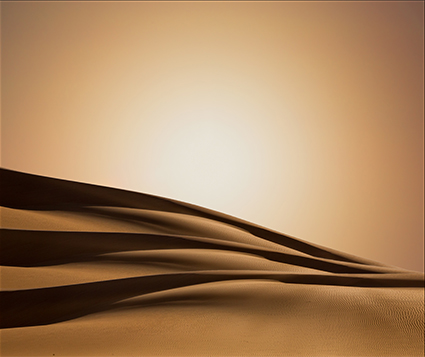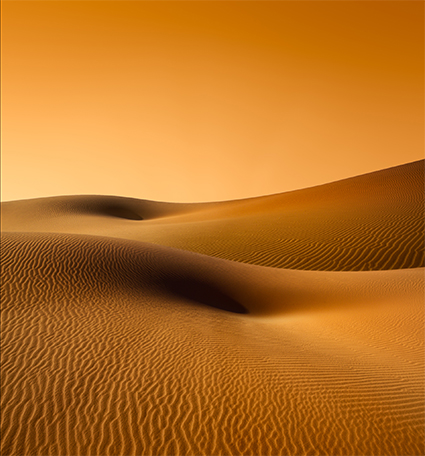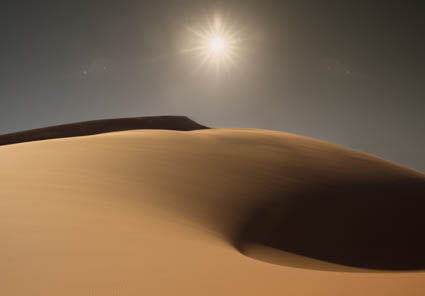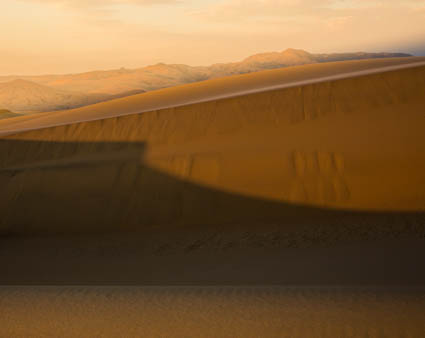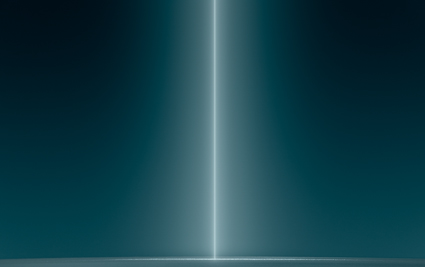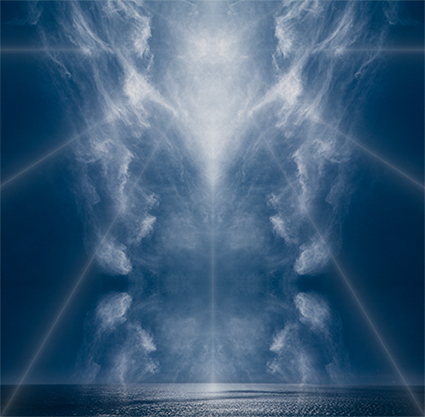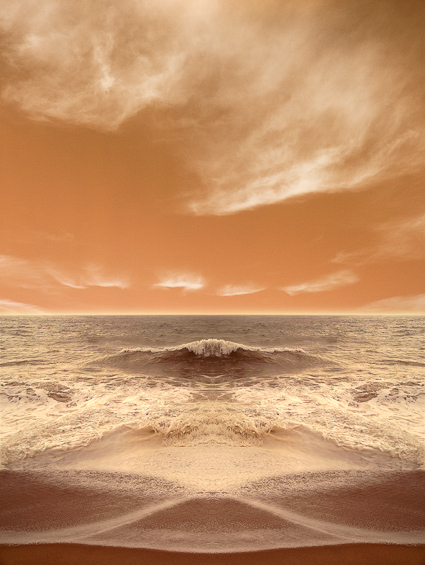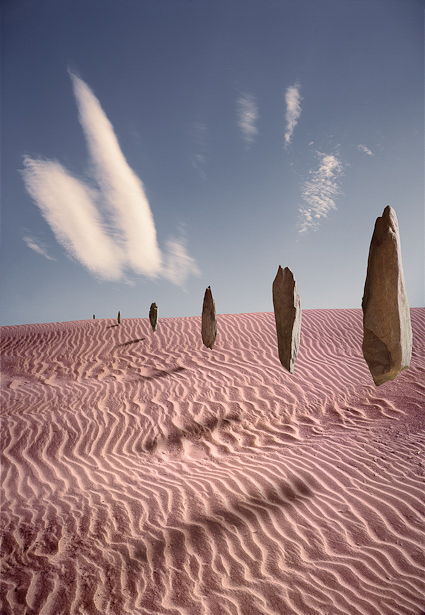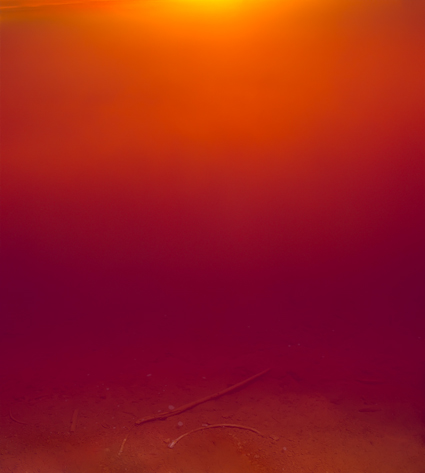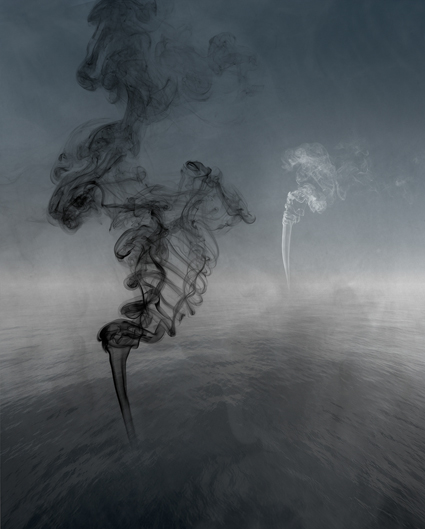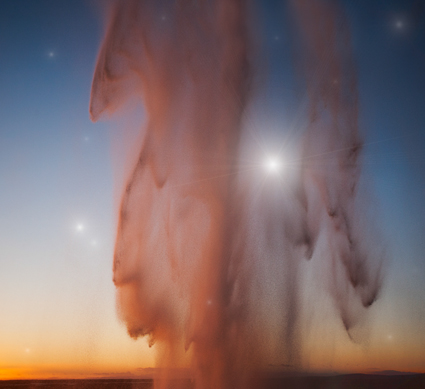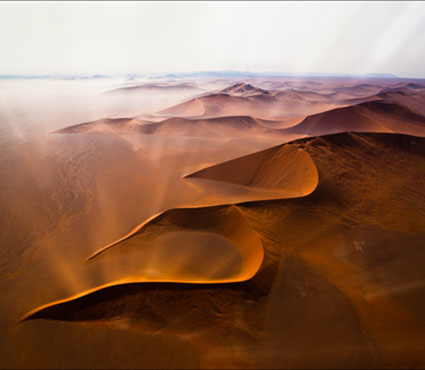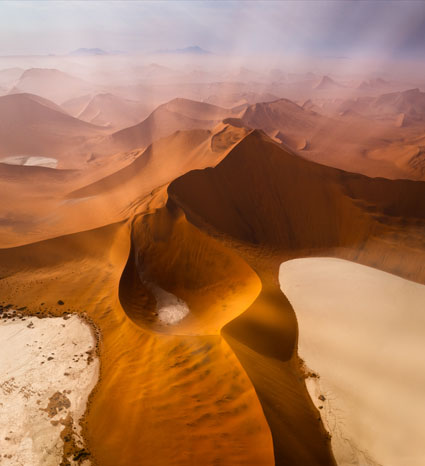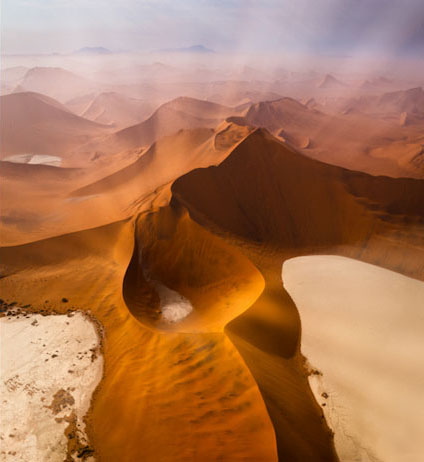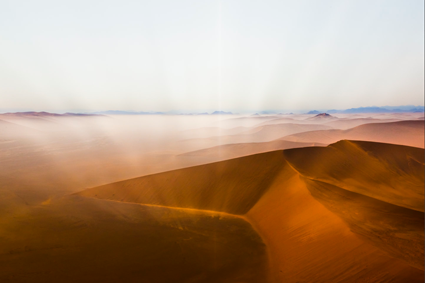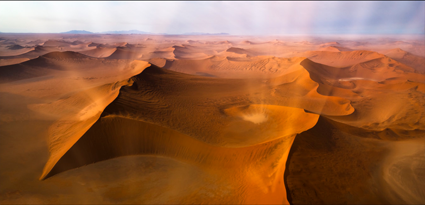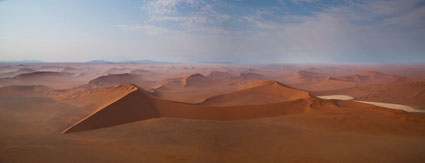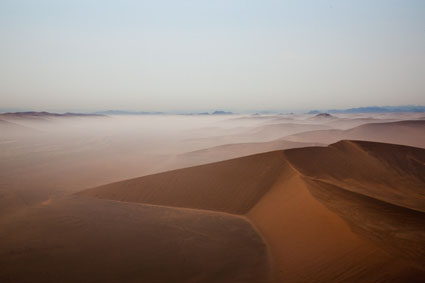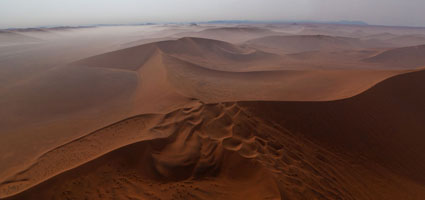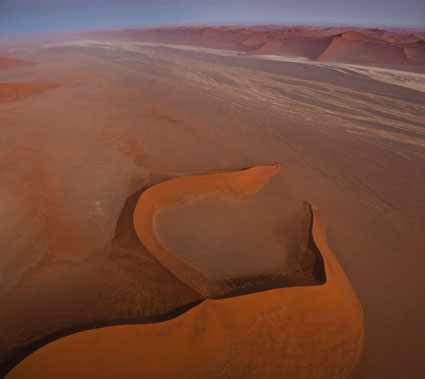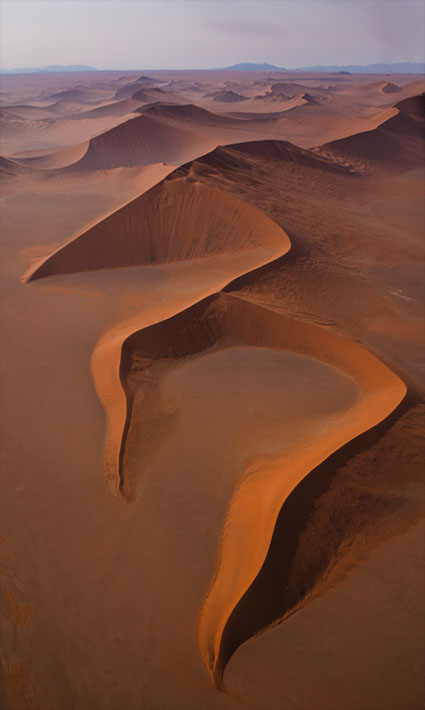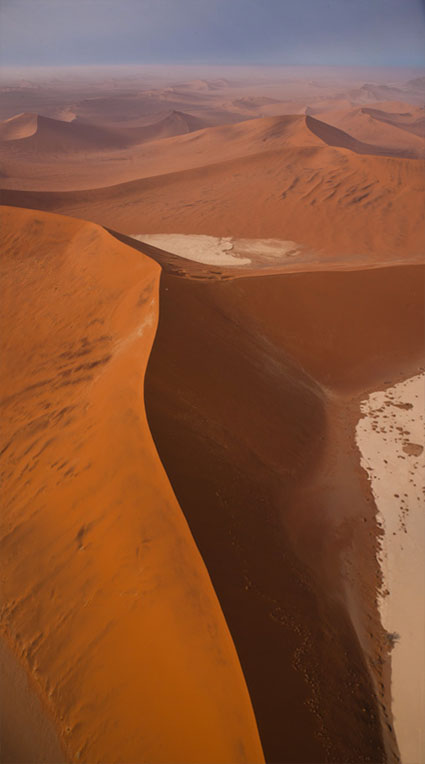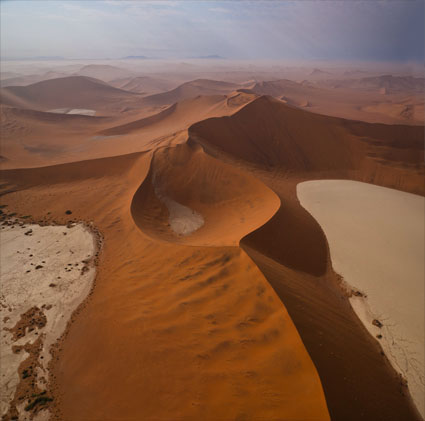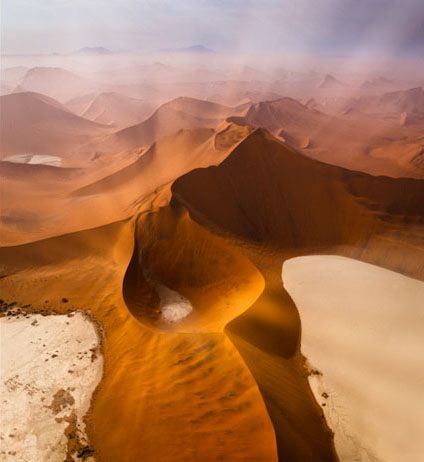
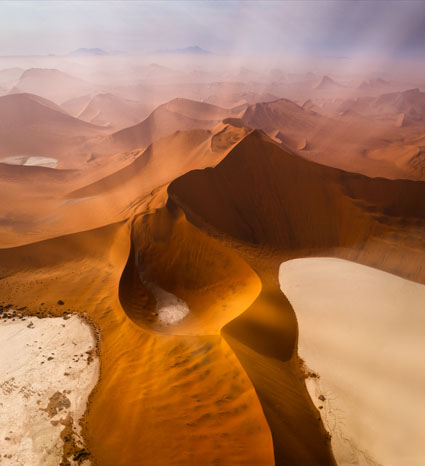
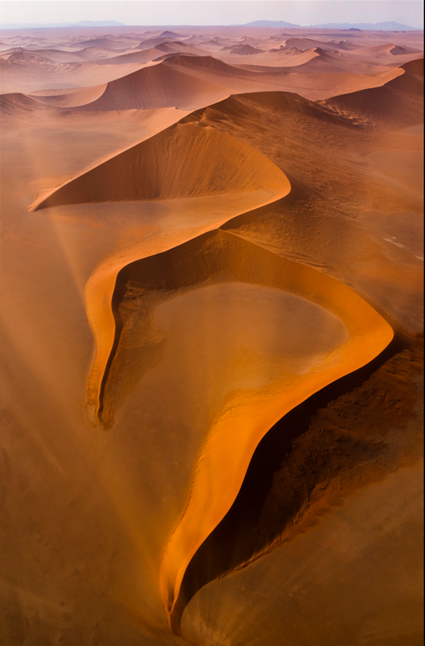
Illumination II, Sossusvlei, Namibia 2012.

In 2010, during my third trip to one of the oldest desert’s in the world, Namibia’s Sossusvlei dune field, I enjoyed one of the most sublime hours of my life, from a helicopter. Moments of grace like this fill you with reverence for the miracle world we live in and a deep abiding gratitude to be a part of it all. I was prepared for it, but nonetheless surprised.

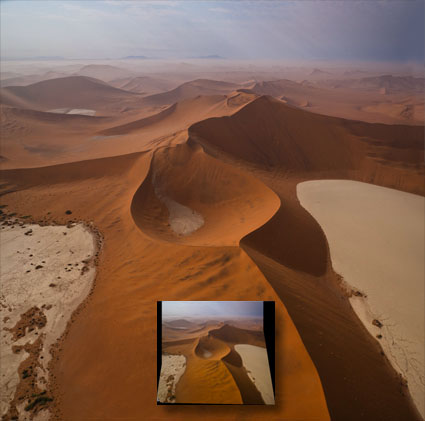
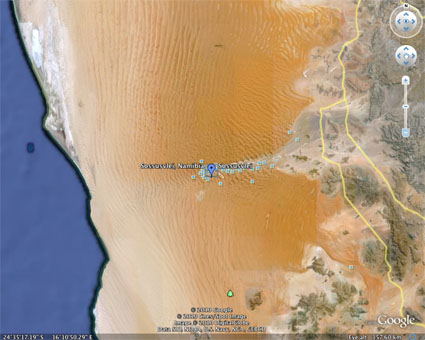
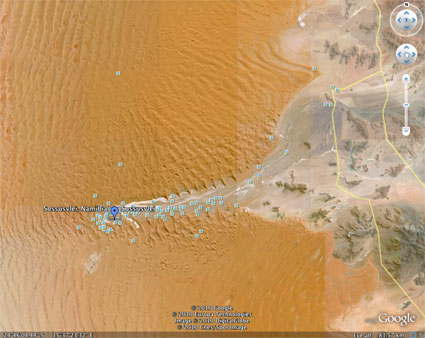
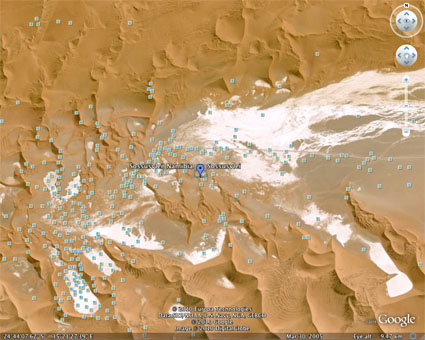
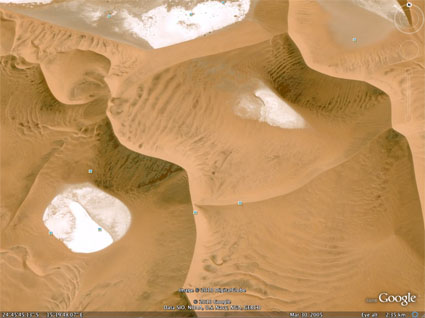
Before arriving, to plan where to go and how to maximize my time this magnificent dune field, I had done a considerable amount of virtual aerial research with Google Earth, zooming and panning images made from the combination of thousands of satellite images at various magnifications, to familiarize myself with where it started and stopped, how it changed in character, and the relative location of landmarks such as the dunes Big Mama and Big Daddy and the famous clay playa Deadvlei.

None of that could have prepared me for the changing angle of light, we were on the second flight of the day, an hour after sunrise, and the atmospheric conditions, all week long, the air was filled with dust from far off sandstorms that scattered the rays of the sun, permeating the sky with a white gold light. On site, I had to assess the impact of current conditions.

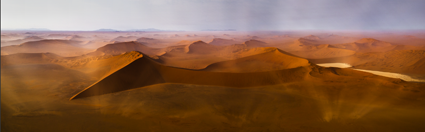
Even at an altitude about 3,000 feet, twice the height of the largest dunes, I found I couldn’t fit the vast dune field into my viewfinder. So I improvised and started making multi-shot exposures for panoramic stitches. It seemed like a bold move, if the two or three shots did not merge successfully then both would be lost, until one of my companions, Paul Tornaquindici, made an even bolder move and requested we do a 360 stationary rotation so that he could make a panoramic image of the entire dune field. To my delight, this method worked.

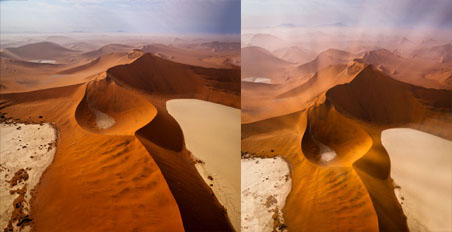
The images lay simmering in my unconscious for more than a year before I found my final solution, to render an effect of light as if it were originating from within the land to complement the light that showered down outside it. Often, a period of gestation is necessary to distill the essence of rich experiences to their essentials and connect them to others.

New image processing features informed the final realization of this image. The body metaphors, latent in these images, were intensified with creative perspective adjustments, using lens profile corrections, designed to remove mechanical optical distortions, now used expressively. Quite different than a change of angle of view, which reveals and obscures information, these distortions offered complementary but distinctly different visual effects, changing relative proportions and spatial relationships within the image. This solidified my previous experiments to compare and contrast the two and so learn to fully utilize them in tandem with one another intuitively.

Unexpectedly, the dynamic explorations made during the creation of this image suggested an entirely new alternate solution – one not fit for print. Animations of progressive distortions made the images appear to pulse and breathe, an effect that is perfectly in sync with my view of land as a living thing with a spirit of its own.

Making this image required pre-planning and then allowing that plan to evolve while responding to new input at each step in the creative process.

How can planning help strengthen your creative efforts?

At what stages and in how many ways can you encourage the evolution of those plans?

When is it better to abandon an old plan for a new one?

What are the positive and negative effects of having no plan at all?

View more related images here.

Read more The Stories Behind The Images here.
I’ve just completed a new suite of images from Sossusvlei, Namibia.

You can view previous images from Namibia here.

You can find more images here.
Crop or Retouch ?

December 22, 2010 | Leave a Comment


As visual communicators, we’re responsible for everything that’s in the frame; we’re also responsible for everything that’s not in the frame. Deciding what’s in the frame and what’s out is a critical decision that can make or break an image. Here are two essential framing strategies.

1.?Use the frame to eliminate distracting information around a subject.

Take extra care with image information that touches the frame, as it will draw extra attention. Do this with significant compositional elements.

2.?Eliminate space around a subject to focus a viewer’s attention.

A lot of space between the subject and the frame can be used to call on psychological associations with space, such as freedom or isolation. Some space between the subject and the frame can give the appearance of the subject resting gracefully within the frame. Touching the subject with the frame strongly focuses the attention of the viewer and may seem claustrophobic. Cropping the subject with the frame can focus the attention of the viewer on specific aspects of the subject and/or give an image a tense quality, evoking evasion and incompleteness—this often seems accidental if less than half the subject is revealed.

There’s more than one way to apply these strategies. While cropping techniques are simple to practice, the reasons for their application and the choices made about how to apply them, as well as the final effects, may be exceptionally complex. You have two choices ..

1. Reposition the frame before exposure.

2. Contract the position of the borders of an image after exposure

If you plan to retouch, you’ll frame and crop differently …

Read more at Digital Photo Pro …

Find more digital photography techniques here.
Learn more in my digital photography worskhops.

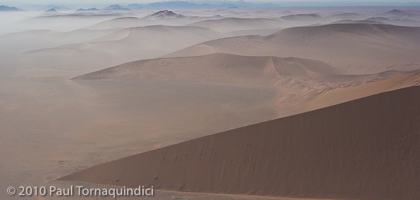
Paul Tornaquindici described our helicopter ride during my Namibia workshop.

“Breathtaking! Strapped into a helicopter- doors removed and hanging out the side seeing the amazing dunes of Sossusvlei from above for the first time. The helicopter moved slowly over the dunes in the morning light as we photographed the remarkable beauty.”

See his images and read more here.
I recommend you seize every opportunity to photograph a location in the air.

When you go , take two cameras with different focal lengths. Use high shutter speeds (1000 plus). Ask your pilot to circle the most interesting areas and vary altitude. If possible, go doors off to reduce reflections. If it’s not, wear a black long sleeve shirt. Keep your lens/shade out of the wind. Shoot fast. As you fly, so will time.

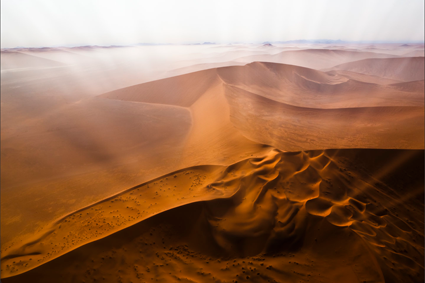
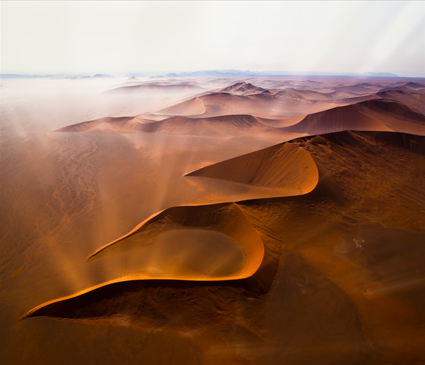
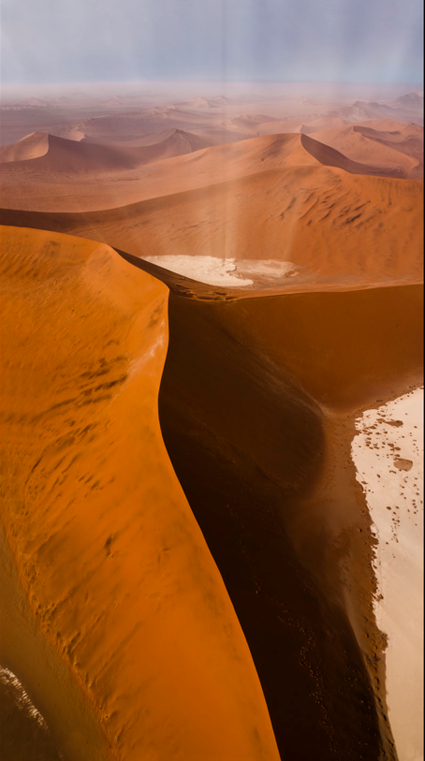
Photographing the Sossusvlei dune fields by helicopter was a highlight for all of us during my recent workshop in Namibia. The views were simply divine. These images are all panoramic merges. We did a full 360 degree pano from the helicopter, just for fun.

Learn more in my digital photography workshops.

See Namibia By Air

July 7, 2010 | 1 Comment

Enjoy a bird’s eye view whenever you can.

We’ve arranged extra time in the air for my upcoming Namibia workshop.

The views of the desert and coastline are truly extraordinary from the air.

Explore Namibia with Google Earth and you’ll quickly see how fantastic it is.

sossusvlei_aerial1

sossusvlei_aerial2sossusvlei_aerial4SossusvleiAerial_5 2

Find out more about my Namibia workshop here.
sossusvleinude
Guiding metaphors can transforms a commonplace perspective into an exceptional one. This enlivens the images you make. I relate to dunes as human bodies. This is sensed by the viewer, always on an subconscious level, sometimes on a conscious level. It helps me to know what my guiding metaphor is so I can intensify this interpretation while I’m on the spot. It makes the work stronger. So when choosing between these horizontal and vertical compositions, I’ll choose the composition that emphasizes that metaphor.

(By the way, it’s always a good idea to shoot both horizontal and vertical. Watch how it changes things. Long after, you may find you relate to the images differently than you do on the spot. But there’s often no going back, so get it while you can. Or should I say, get both while you can.)

Visit here tomorrow for more of my images from Namibia.

Find out about my 2010 Namibia workshop here.
sossusvleiclassic

sosussvleipanoramas

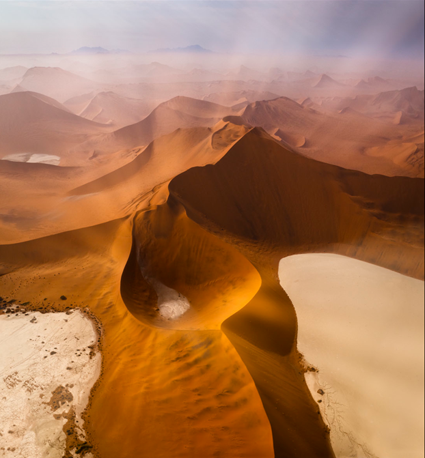
Sossusvlei, Namibia has some of the most famous dunes in the world – 750 foot high coral dunes that close in towards one another as you move up the valley. When you think Namibia, you think Sossusvlei. Everyone who goes there has a similar version of my first shot. I took it too. Then I tried a different approach. I found the dunes made wonderful abstract panoramas.

Visit here tomorrow for more of my images from Namibia.

Find out about my 2010 Namibia workshop here.
Subscribe

Get the RSS Feed  

Subscribe by Email


    Categories

  • Archives

  • Blogroll

    Topics & Friends