

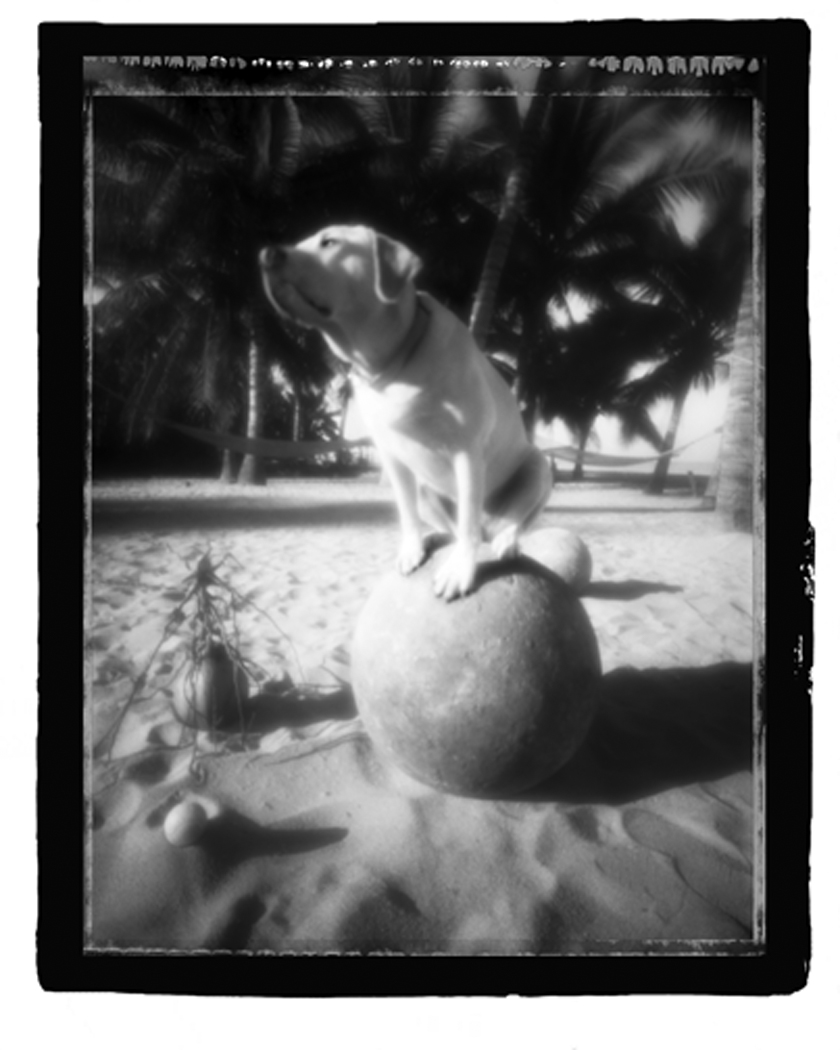
Christopher James
Christopher James is Chair of the photography program at The Art Institute of Boston at Lesley University and an internationally recognized artist and photographer whose paintings and photographs have been exhibited in galleries and museums in this country and abroad. His work has been published and shown extensively, including shows in The Museum of Modern Art, The Metropolitan Museum of Art, The George Eastman House, and the Philadelphia Museum of Art. The first edition of his book, The Book of Alternative Photographic Processes (Delmar, 2001) has received unprecedented critical acclaim, was the winner of The Golden Light Technical Book of the Year award, and is recognized as the definitive text in the genre. The second edition of The Book of Alternative Photographic Processes was released in February 2008. James was a Professor at Harvard University from 1978 – 1991 and has lectured and given workshops throughout the world.
JP Quickly, sketch your photographic career.
CJ My mom used to tell me bedtime stories about Margaret Bourke White.
Although I got into photography primarily to photograph anti-war demonstrations for student resistance groups, I began using it extensively to solve graphic design problems when I was earning my BFA at Massachusetts College of Art.
I am self-taught and have never had a photography class.
Then there is a long, and interesting, story about living in a commune and learning photography in the late 60’s, running hoses for water, using black silage plastic to black out a barn, and developing film in long neck wine bottles.
When I went to RISD for graduate school I began investigating how I could alter photo-chemistry and how those alterations could be employed to change colors, surface illusions, and tones. I wanted to create photographically generated (light / marking) images that were hand-made and unique. This led to a career of making conceptually personal photographs via chemical alterations, hand painting, and alternative processes.
I discovered that a great deal of the literature of alternative process photography was filled with errors and instructions that were over complicated, opaque, and simply wrong. About 33 years ago I had the opportunity to teach a workshop at the one-year old Maine Photographic Workshops and decided to do a non-silver, toning, and alternative camera and process workshop. Since then, it has been the boat that I sail in.
JP Which moments have been the most inspiring?
CJ I’m not entirely sure what you mean here. Most every inspiring moment in my life has been visual but very few of the experiences, with the exception of some of my work in India, have been photographic.
My imagination and memories are more important to me than the evidence of a photograph. That said, I believe the act of making a photograph, which relies heavily on life experiences and conceptual problem solving, is immensely inspiring and easily the best part of being a photographic artist. The product of the print pales by comparison to the inspiration of the process making it.
JP How has photography changed you?
CJ Having survived the attrition of the medium, I would have to say that being a photographic artist / scholar has made every difference, and been influential to my life beyond measure.
JP So how has it changed you? Do you see the world with new eyes? How often does this happen? Are these moments of change subtle sustained accumulations (compound interest) or dramatic paradigm shifts (market fluctuations)?
CJ I suppose if I could go back in time and use my old eyes for a spell, while keeping my present knowledge and abilities to comprehend, evaluate, and conceptualize, I would notice that I had changed. I imagine it would be like visiting a childhood home as an adult and being startled that it had become so small. Photography has been, for me, a ship that has allowed me to experience a vast universe of possibilities. The medium has given me the best possible way of living a life, on every level I could have imagined when I boarded this vehicle at 18. I’ve been very lucky and fortunate to have been prepared for that luck when it showed up. I tell my students that this is one of the great truths of surviving as an artist in America.
So, to answer your clever question, the analogy would be subtle compound changes that keep my interest.
JP In learning to make photographs, we learn to see differently. How has photography changed the way you see?
CJ A complicated question.
Perhaps another way of discussing it would be to ask how has the work of other photographers influenced the way I thought about how things could be seen? As a young photographer, there were relatively few published collections of images that you could turn to for reference or inspiration. For me it was Robert Frank’s, The Americans (1958), Danny Lyons’, The Bikeriders (1968), your father’s 1967 photograph, Running White Deer, and Eugene Smith’s, Tomoko in her Bath (1971). These images challenged the way I thought about photography and changed the way I learned to see.
To me, visual literacy is the ability to see. More specifically, it is the capacity to interpret, associate, and communicate signs, symbols, codes, signals, metaphors, and marks. A visually literate person is able to draw on a knowledge base that includes cultural and art history, criticism, and semiotics, which is the study of how meaning is established and understood.
JP How would you characterize your personal preoccupations with regard to subject matter?
CJ Almost any answer to this question is going to sound contrived and self-special. I make photographs of things I would like to look at, and think about, later. I’m interested in mystery, darkness, and how light has a redemptive quality when associated with the density of a photographic black. I like to be amazed.
JP How would you describe your signature style?
CJ I’m not sure. I think my best work (and there are perhaps 4-5 images I’ve made in my life that I think can stand the test of time and looking) has weight and mystery and that it is, in a strange way, bigger than life. Honestly, I think my best images have the best stories attached to them.
JP Many people invested in the history of photography and historical processes have resisted incorporating digital technology in their processes and even approving of others doing so. There has been a misguided notion that new technology replaces old technology. In the field of alternative processes I’ve seen quite the opposite. Digital contact negatives have made it easier and more economical to access historic processes. As a result of digital technology, more people are making photographic prints with historic processes than ever before. Has this been your experience? What else would you add here?
CJ I became a believer in the possibilities of integrating digital technologies with alternative process image making about 10 years ago when people began talking about how digital imaging would destroy wet lab based image making, how film and paper would eventually disappear, and how the world would end because of 1’s and 0’s.
In the first edition of The Book of Alternative Photographic Processes I did my best to address the history of digital imaging and to provide a digital workflow (with your help, thank you) that could serve as a way of generating separation negatives for gum bichromate printing… since doing it in camera or the darkroom was such a laborious pain in the ass.
In the second edition I have been able to really tighten up the digital workflow for producing contact negatives for every process, add filtration instructions, utilize Pictorico inkjet films (with the ceramic dust coating for better absorption and texture), and Epson printers (I love my 2400!) It is now possible to make incredibly perfect large scale contact negatives with only a brief amount of instruction. It’s become so simple that I now have a negative production set up in my workshops and use the technology as a way of greatly accelerating the learning curve in alt pro.
JP What about the fate silver gelatin? To date, it has required a larger manufacturing base to make accessible. This casts some shadow of a doubt as to its longevity. Yet, I have faith in human ingenuity. I think someone, somewhere will find compelling ways to keep this medium alive and vital. Do you see it surviving the transition into the 21st century, where digital technology has become the dominant paradigm?
CJ The long running show of silver-based gelatin films and paper is coming to an inevitable end. This “traditional” image making system will probably be designated an official alternative process in the next few years but since it is not yet on life-support, I have refrained from including it as a chapter in the new edition. The people who loved photography for its accidents, expression, and unpredictability are moving in droves to alternative process image making. This transition is not at all unlike the artistic tsunami that swept through the contemporary painting world in the late ‘50s and early ‘60s and it is healthy for the genre. I saw these changes coming a few decades ago when I first began offering alternative processes classes at Harvard. Many of my former students from that time are in this book and have made a life for themselves in the medium. It is clear to me that photography is now a part of every visual discipline in some way or other and if it is to have a place of its own, as an art form, that place may be the realm of handmade photosensitive imagery.
I think the artists of the 21st century are going to find that alternative processes provide an outlet for the hand of the artist to be in play again, as it has since it’s beginning. There will be, of course, artists such as yourself who will use the tools of digital technology in a personal manner.
I think, however, that this approach will be unique as the hardware and software of the digital revolution has resulted in a model that is taking photographers back to the salon ethics of the past where a “good” photograph was one that simply demonstrated a perfection of technique. That outcome is possible to everyone these days, as long as you can afford to buy the tools and software. With digital imaging hosting this new “mushy democracy” of photographic expression; one in which the equipment finds the faces, exposes for neutral feeling, and then makes the perfect print, there is a (forgive the theater in the next word) hunger for the accident, the raw imperfect light and texture of life.
That said, I nonetheless believe the future of photography as a distinctive medium is to be found in its past. Contemporary alternative process artists are, as Lyle Rexer coined well, the antiquarian avant-garde. France Scully Osterman and her husband, Mark Osterman, call this approach to photography “photo-humanism” and those who embrace it “photo-humanists.” It’s all about the human reference in both the vision and crafting of photographic imagery. The light-marking art they produce, and how they define their creative process, is flourishing as a language without compromise, or conditions … one that is not tied to a syntax-dependent feast (as perfect as it is) of 1’s and 0’s. Think about this, it’s possible that all it will take is a decent solar storm, like the one that occurred in 1859, and 17 hours and 40 minutes later every hard drive on the receiving end of that solar flare will instantly become a good doorstop.
JP In your own work (and teaching) you’ve favored an exuberant inquiry into a variety of processes. Why are you so fascinated in media and processes?
CJ I’m really only interested in the creative process of the individual and the unique expressions of the conceptual and curious mind. I believe that hand made media and processes offer up an unlimited menu of possibilities and that is why I love it so much.
JP Celebrate the merits (and differences) of your favorite media for me.
CJ I love the surprises and unpredictable nature of the hand made photographic image. I love the construction of the formulas, the hand painting of sensitizer, the working environment of the outdoors and the sun, of making minute changes to any facet of the process in order to realize a different result and impression… and on and on. I can become really evangelistic when it comes to discussing the hand made image.
JP If looking is a sensual act, a proliferation of media expands and enhances artistic expression. This is what I see occurring today. Do you? What excites you most about this? What concerns you most about this?
CJ I don’t know how to answer this question. I’m not sure I think looking is a sensual act. Not to take away from a perspective that I think you hold dear but looking and seeing are more basic to me and have more to do with physical living than sensual perceptions.
JP That’s what I mean by sensual. It’s a product of being physical and interacting with the world. Optionally, you can extend this further to include the emotional and cognitive processes we engage in as a result of initial physical stimuli. Let’s try this another way. If you were an oenophile celebrating your favorite wine (from the looking/seeing winery, vintage your favorite year), how would you describe the experience of drinking it?
CJ That would be a 1974, Heitz Cellars, Martha’s Vineyard. I read that this was the only 100 point wine ever made in the United States and 20 years ago I traded a piece of my work for 3 bottles of this vintage. I drank one of the bottles with Craig Stevens because he was the only person I knew at the time who would get blown away by it. I shared the second bottle with my wife Rebecca at the millennium, and I’m saving the third bottle for my friends when I’m gone. I would describe the experience of having a sip of this wine as a complete and total mind-@/!#. Nothing you could ever eat or drink after that sip would be as physical, stimulating, or life enhancing.
JP Tell me about your book – “… Alternative Processes”. (Why did you decide to write it? Who is it intended for? What benefits has it had for your readers? What did you learn as a result of engaging the project?)
CJ All good and complicated questions. I decided to write the first edition because I was asked to by the publisher (Delmar, now Cengage Delmar). This sort of thing doesn’t happen very often so I agreed and then started to organize nearly thirty years of notes on alternative process photography. Other reasons for writing it: I was weary of photocopying my notes for all my students and I thought it would be a great place to correct the mistakes found in so many alternative process texts of the past.
Benefits for the readers include: (from the back of the book) • Examines the history and techniques including: lensless cameras, calotype, salted paper, anthotype, cyanotype, argyrotype, chrysotype, POP, kallitype, ambrotype, wet collodion & gelatin dry plate emulsions, Van Dyke, platinum / palladium, Ziatype, carbon, gum bichromate, albumen, alternative paper, emulsions, & imaging systems, and digital negative workflows. An extraordinary and abundant visual resource with rare historical images and abundant contemporary work from artists, including; Sally Mann, Michael Kenna, Chuck Close, Dan Estabrook, David Hockney, Christopher James, Anselm Keifer, France Scully Osterman & Mark Osterman, Luis Gonzalez Palma, Judy Seigel, George Tice, and Mike Ware. As well, there is a significant collection of student work to “set the bar” in any learning environment. • Complete table and sink set-ups for all alternative processes • Extensive appendices including: chemistry and safety, resources, supply lists, conversion tables and historical & contemporary bibliographies.
I surprised myself with the first edition. The second is far more extensive in scope, page count (660) and imagery (400). I learned that I could actually make the book that I truly wanted to make and that it was possible to convince a large publishing house to give you free reign to make “the best book possible” because of your convictions to do just that. The people at Delmar Cengage are about the best you could ever hope to work with in publishing.
JP Do you have a favorite alt process?
CJ I love all my children equally… just some of them more on certain days. Some processes have a sense of humor, like gum bichromate and cyanotype. Others are often naughty, like salted paper and wet plate collodion. Albumen and kallitype are generally well behaved… and all of that doesn’t mean a thing if things such as altitude, weather and humidity, paper type, water source, time of year, and such, change. Hard to pick a favorite… I guess whichever one is treating me well at the time you ask… at the moment albumen with tapioca starch and gold toning is my favorite.
JP Celebrate a few alt processes for me as a connoisseur would.
CJ OK… The salted paper process is unpretentious, low in acidity, with hints of pencil lead and musty cork and intense spicy aromas of cinnamon, beach plum, and low tide. It has an “old world” nose and often pampers the optical palate with a touch as light as a feather. A perfect salt print has shades of aubergine and is delicate, subtle, understated, and prized for its shyness.
The kallitype is a muscular and exuberant process possessing, upon first impression, a rich, briary, saddle leather, and full bodied character that would pair well with sardines or fried clams. It is so black it even tastes tarry. But if the intensity of the blackness borders on too severe, it redeems itself with textural finesse. Often mistaken for platinum, the kallitype has a reputation for yellowing in its highlights, a condition that can be rectified by developing it in a soothing blend of sodium acetate and ammonium citrate.
The anthotype is a charming and organic process that celebrates all of the components of a great honeymoon… flowers, alcohol, and long exposures to sunlight. It is a fragrant and aromatic process that is chemical free, magical, and yields a romantic and diffused image that Pre-Raphaelites and grammar school children love.
The gum bichromate process is a mischievous little technique that is renowned for rewarding the playful and patient. Practitioners who indulge in this time consuming exercise are universally pleased with a full throttled and multi-chromatic runway to creative adventure. Gum prints are dense, chewy, and robust and improve with age. When they have reached their perfect end, they are loaded with opulent, even unctuous layers of fruity coloration, and a huge bouquet with a plump, luxurious, texture that is quite decadent.
JP You’re an outstanding teacher (department chair at Art Institute of Boston and longtime instructor at the Maine Media Workshops). You have a unique ability to fill your students with enthusiasm. Tell me about a few of the most successful ways to achieve this.
CJ It’s really simple. I let my students know that there is no other place that I would rather be and that I love doing, and teaching, what I do. I believe this and because students have a finely tuned BS meter they know that I am telling them the truth. I respect what they have to say and I listen to them. I also ask them about their work and their intentions rather than “tell” them about it. I learn from my questions and they learn through their answers. In the end, they think they taught themselves, which is, as you know, the only way to learn anything well.
JP You also celebrate diversity in vision and in media. What drives this?
CJ Fear of being bored out of my mind with clichés.
JP Has helping facilitate others to find their authentic voice helped you find or refine your own?
CJ The twin benefits are intertwined and inseparable. If you can’t learn and be informed while you are teaching then all you are doing is talking.
JP What other benefits have you derived from helping others?
CJ Simply paying off the debts of favors given to me during my life.
Every time I write a letter of recommendation for someone I think of how important that letter is to the person who asked me to write for them. I also think about how Al Hurwitz wrote a letter of recommendation for me in 1970, to RISD’s graduate program, three weeks after the deadline for applications and how that well crafted letter got me into the program.
JP Do you think it’s essential for today’s photography students to study historic processes before engaging current media?
CJ No. The two genres are related but not essential to one another for life and happiness. I believe that the study of history, both art, photography, and cultural, is more valuable to a student in the early stages of their life in the arts.
JP Is it essential to practice them at all?
CJ If you don’t want to fall in love with a hand crafted process I would stay away for alt pro. It’s intoxicating to make beautiful objects / prints by hand using the sun and hand mixed chemistry.
JP Is it important to at least understand what they are, how they evolved, and the impacts they’ve had on the medium?
CJ Yes.
JP You’ve also been involved in several vital artistic communities. How has that activity influenced you?
CJ I hope that the involvement has made my life more interesting and informed. Honestly, I tend not to separate my photography from my painting, from my writing, from my teaching, from my diving, from anything that I love to do. Each experience and “community” is part of a whole life lived well and that is, I think, the point of it all.