

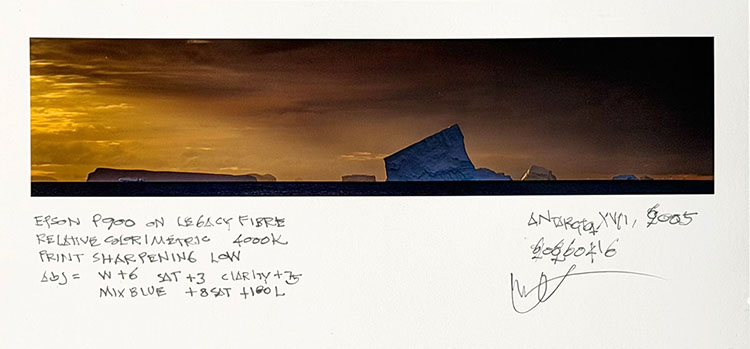
BAT
BAT, bon a tire, it’s French for “good pull”. Classically, it refers to a final proof print. For centuries, it has been a time-honored tradition to keep a final proof on file, a reference for evaluating prints over a large print run or when reprinting an image. BATs are also useful for small runs, ensuring that subsequent prints will be of equal quality – or better.
To be definitive, a BAT must be printed as the final print will be printed using the same image file, printer, ink, paper, software, profile, and driver settings.
There are several practices that make creating a BAT particularly easy when printing digitally.
Make Notes
Make notes of any choices and adjustments you make as you proof. Annotate every proof with enough information to retrace your steps. It’s easy for proofs to get shuffled, and then you may have to start over.
Make more comprehensive notes on the final proof (the BAT). Include printer, ink, substrate, profile, rendering intent, the light temperature the proof is intended to be viewed under (5000K or 3600K), output-specific adjustments including output sharpening, and the date the proof was created.
Sign only the final BAT, not the intermediary proofs. This is particularly important when a proof is made for someone other than yourself. Their signature confirms they have reviewed and approved the proof. The BAT becomes a visual contract with your client.
With these items recorded, you can read the proof to help you identify relevant factors that contribute to print quality (for a specific image or for general purposes), and you can efficiently retrace your steps in subsequent printing sessions. If at any time a future proof does not match the original proof, you will be able to quickly identify the variables in the printing conditions that have changed.
Don’t make BAT notes on the final print(s). You may want to annotate your finished prints with information relevant to collectors; on the back – title, materials, date printed; on the front – edition number and signature. Use a pencil for matte surfaces. Use a pigmented ink for photo surfaces.
Think About Scale
Though not all proofs made during a printing session are at full scale (proofing at a reduced scale can save time, materials, and money), a BAT is typically made at or near full scale, allowing accurate assessment of detail, sharpness, edge quality, and noise. Adjustments for the subtle shift in an image’s appearance across scales can also be accurately assessed: larger images appear lighter and contain less contrast. That said, while slightly less accurate, even BATs made at reduced scales are still extremely useful references for future printing.
Organize BATs For Easy Future Retrieval
File all your BATs in an organized manner so you can retrieve them quickly. Though you may wish to, it’s not necessary to keep all the proofs from a proofing session. Consider keeping the very first proof pulled without additional adjustments, as it can be used to compare previous printing conditions with current ones, separate from session-specific adjustments. Always keep the BAT.
Reproof When Necessary
If a significant amount of time has passed since you initially proofed an image, make a new proof using all previous proofing conditions to confirm that conditions have not changed. If slight shifts have occurred, continue proofing from that point until you get the results you want. More significant changes may occur when you change materials (inks, papers, profiles), and you may need to remove old adjustments and make new ones. If enough time has passed, your technique and/or sensibility may change, a little or a lot. BATs don’t limit you; they simply ensure quality control. It can be illuminating to see the evolution of an image’s print quality and your interpretation of it. Replace old BATs with new BATs after each new proofing session. If you choose not to discard old BATs, be sure to refer to the most recent BAT as your mark to meet.
Remember, when reprinting, don’t slavishly follow BATs. They simply set a standard to meet. Hopefully, you can exceed it as your media, technique, and vision evolve.
Explore more Printing resources here.
Learn more in my digital photography and digital printing workshops.
Sorry, the comment form is closed at this time.