

Unlocking The Secrets Of The Creative Process – A Conversation Between Eric Meola & John Paul Caponigro
August, 2017
Eric Meola
What is the process of creativity? Where does it come from, and how does it evolve? Recently, photographer and PPD contributor Eric Meola raised those questions in an interview with photographer and educator John Paul Caponigro, whose work will soon be featured along with his father’s in a major new exhibition at the Taubman Museum in Roanoke VA, “Paul Caponigro and John Paul Caponigro: Generations.” Today we publish part one of the interview, in which Caponigro and Meola talk about chaos, self-doubt, reflection, serendipity, failure, discipline, and the myriad facets of interaction that lead to creativity and art. Look for the rest of the interview in upcoming editions of PPD.
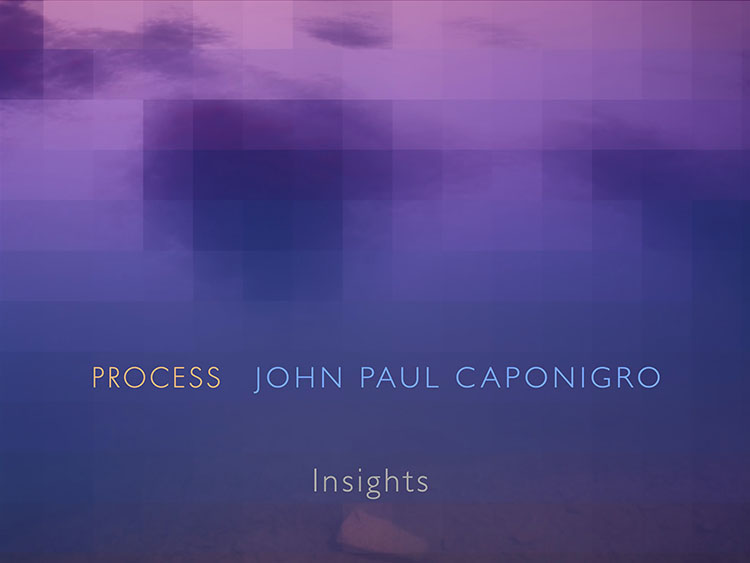
At a recent workshop in Maine, the noted National Geographic photographer Sam Abell asked his students to photograph a poem—to illustrate the words with images. Abell wanted the students to think about the relationship between two methods of describing imagery, and the challenges posed by interpreting words and images in our minds through photography. The dichotomy between words and images has haunted me throughout my career, and then a few months ago, a nearly 200-page PDF attachment of an e-book called Process arrived in my email as a gift from photographer-lecturer-educator John Paul Caponigro —or JP, as his friends call him. I glanced at a few pages, then put it aside on my computer’s desktop to look at later. I had met JP on several occasions—first in California before we were both scheduled to do lectures, and then again in Iceland, Antarctica, and the Atacama desert while participating in Digital Photo Destinations workshops (www.digitalphotodestinations.com). I had only a few sketchy things to go on—that JP had graduated from Yale, that his father was the photographer Paul Caponigro, that he had grown up in New Mexico, and that he took a few weeks off to go to Italy every year.
So one day, when I got a call from my somewhat inebriated photographer-friend Arthur Meyerson and an equally inebriated JP as they joyfully celebrated the close of a Maine Photo Workshop, I told JP that I had not only read Process but that I wanted to interview him about it. I had a lot of questions: How was his famous father? Did his mother really design Ernst Haas’s book The Creation? And most importantly, what the hell was Process really about? After all, we live in the age of iPhone photography, when nearly 300 million photographs are uploaded to Facebook every 24 hours.
In the book Invisible Republic: Bob Dylan’s Basement Tapes, critic Greil Marcus describes the process that led to Dylan’s collection of more than 100 mostly unreleased songs; the music evolved from—in Marcus’s words—“a laboratory where, for a few months, certain bedrock strains of American cultural language were retrieved and reinvented.” Few photography workshops explore the creative aspects of photography as a constantly evolving set of inputs—reading, writing, sketching—that manifest themselves in the way we make images. I recognized that many of my inputs had much in common with what JP was discussing, but I wanted to know more about him and why he always seemed to be “looking away” from the image in front of us. Or was he?
Our conversation, which begins below, took place over an extended period via email, while JP was with his family in Italy.
EM: I’m fascinated by your approach to seeing, to “living” photography, which you refer to as “process.”
JP: Art arises out of a life lived—it’s an extension of ourselves, our creative process grows and changes as we do. Art is not something separate from life. Art intensifies life. Some cultures don’t have a word for art, considering the items/events produced that we might call art to be an overflowing of life. Seen from that perspective, everyone is an artist. So the follow-up questions would be: What kind of artist and how well do they do it?
EM: Your father is Paul Caponigro, a master landscape and still-life photographer. He once said, “It’s one thing to make a picture of what a person looks like; it’s another thing to make a portrait of who they are.” That applies to all photography, doesn’t it—from landscapes to journalistic images to portraits?
JP: Exactly. Representation is not reproduction. We make portraits of people by recording light reflecting on their bodies—often only a portion of their bodies, usually from one angle and at one moment in time. Does such an image record their changing state through time, their history, their web of relationships, their ideas, their feelings, etc? It’s important to recognize the limited nature of our creations. In representation. it’s important to recognize the gap between what we create and what’s referenced. This doesn’t make these types of images less valuable; for many people they’re the most valuable. Perhaps those limitations can be used for effect?
EM: You recently did a print “pair” with your dad, who lives with you. His image “Galaxy Apple” is one of my favorites. How is he, and how much did he influence your own way of thinking about images?
JP: Dad’s “Galaxy Apple” is one of my favorite photographs, too. Its ability to speak both literally and metaphorically at the same time is one of the possibilities photography presents that fascinates me most, and it influenced my decision to become involved in the medium.
Dad’s influence on me as a person and an artist has been tremendous. How could it not be? He’s my father! In addition to influencing the course of my early life, presenting many interesting experiences, and influencing my world-view, he’s always been available personally, generous with his knowledge, and supportive of me as an artist. He’s an exceptionally sensitive human being. Among many other things, I appreciate his independent spirit, his unconventional thinking, and how willing he is to chart his own course. Without the influence of both of my parents, I doubt I’d be as interested in spirituality, comparative mythology, relationships between man and nature, and music.
At 82, Dad’s sharp and active. And yes, he’s still working—we’re going to do another print pair together soon.
EM: Your mother, Eleanor, was also an influence, I presume—after all, she designed the most influential book of photography ever—Ernst Haas’s The Creation. You must have been four or five years old at the time… did you meet Haas at that young age? What was it like to grow up in a world of art?
JP: Most people don’t know how big an influence my mother has been to me. She’s been as strong an influence on me—both as a person and as an artist—as my father. She was the painter in the family and started me drawing. She kindled my interest in “sacred” geometry and numerology. She taught me most of what I know about offset reproduction, which helped me tremendously in making the transition to digital printing and in consulting for corporations producing printers. She laid the foundations of my understanding of graphic design. She showed me the power of editing and sequencing images by helping many artists select, sequence, reproduce, and present their images. She showed me the contributions a second pair of eyes can make to artistic growth. Shall I continue?
My parents’ very different interests in and uses of language sparked an interest in verbal communication and writing. Their very different sensibilities for music displayed personal voices. I experienced both of these on an almost daily basis.
As I’m writing this, a pattern in our family of artists has become clearer to me! All of us didn’t pursue careers in other arts, despite a lot of dedication to them. Mom didn’t pursue a career in painting; she became a graphic designer. My father didn’t pursue a career in music; he became a photographer. I didn’t pursue sequential art—filmmaking and graphic novels. Or did I in an entirely different way than I was thinking?
There are so many benefits to making the visual verbal. I wrote about that in this blog post: Making the Visual Verbal
EM: You grew up in New Mexico, among other places, and as a child you met Brett and Cole Weston, Ansel Adams and Georgia O’Keeffe. Can you tell us a little about that? Did you have any sense of who they were?
JP: I was born in Boston, and my family moved to Ireland for a year when I was two. Some of my earliest memories are when dad began to photograph megalithic monuments there. Then, after five years in the Connecticut woods, we moved to the high deserts of New Mexico—first to Pojaque (I went from a school where there were two African-American kids to one where there were two Caucasian kids…the rest were Hispanic and Native-American) and then to Tesuque, near Santa Fe.
Santa Fe was the kind of place where you’d walk into a restaurant and see a Navajo medicine man sitting with a Spanish rancher, an Impressionist painter, and a nuclear physicist—today you have to add a Tibetan monk into the mix. After a great private high school, Santa Fe Preparatory School, I attended Yale University and later the University of California at Santa Cruz; in addition to a great education, I got a great education in education. After college, I moved near the Maine Photographic Workshops, not realizing that Kodak would soon set up The Center For Creative Imaging nearby and that as an artist in residence, I would experience a dream come true—Photoshop. Many years earlier, while my mother was overseeing the production of Eliot Porter’s Intimate Landscapes book, I was shown a Scitex machine, which my mother called “a million-dollar coloring book.” I whispered under my breath, “What if an artist got hold of one of these? I wish I had one!” That wish came true. We traveled a lot, and I met a lot of interesting people—that was as much a part of my education as my formal education.
As the son of two parents involved in different but related aspects of the art world, I’ve had meetings with many remarkable men and women. I met all of the people you mentioned and many more. Not all of them were famous. Many people wouldn’t recognize the names of people I met who were very influential to the photography community. Our family of artists would visit artists, curators, dealers, and publishers—or they’d visit us.
When I was very young, I had no idea how other people regarded these people. When I was a kid accompanying my father when he taught in Yosemite, I knew Ansel Adams made beautiful photographs and played the piano beautifully, but to me Ansel Adams was really cool because he had a three-legged dog named “Tripod,” even cooler because he had a tiny adorable wife who often seemed like a fairy-tale character, cooler still because he had his own gallery and workshop program in Yosemite National Park, and the coolest guy on the planet because they told me he had a stick he used for controlling the clouds—that is until I couldn’t find a cloud stick in his camera bag like they said. My appreciation for him deepened when I was older and began to understand how much he did to help other artists and the environment.
As I grew older, I began to realize that other people looked at and treated these people differently. Often, they treated my father differently; sometimes, they acted differently. I’ve witnessed a lot of inflated behavior. It’s rarely pretty.
For the most part, my parents didn’t change the way they related to people of notoriety—and neither did I. As a result, I’ve got a somewhat different relationship to celebrity. While I’m interested in what fame does to people’s behavior, fame doesn’t change the way I think and feel about them.
I’ve seen people change their behavior because they became famous. I sympathize, but I don’t respect it. I do respect people who attain fame and don’t let it go to their heads. Fame can take a terrible toll on people and the people around them, especially their families. It even takes its toll on people who react to fame in inflated ways. To some, it can be a sign of respect and a relief to stop the nonsense and just be real. While I wish success for everyone, I wouldn’t wish celebrity on anyone. Or rather, I wish our culture’s reactions to fame would mature. I celebrate examples of people using their notoriety conscientiously.
To me, while she’s one of my favorite painters, Georgia O’Keeffe was a grouchy old bat who told me her dogs liked only her (after I’d been licked for hours waiting for my mom to finish working with her). But, aside from being very talented, she was also very intelligent, and I gave her lots of brownie points for recognizing, respecting, and valuing my mother’s talents and contributions when they worked together on projects.
I was deeply impressed by Eliot Porter, who worked with my mother on many projects. He was a Harvard-trained microbiologist who was influenced by Thoreau and who devoted his life to the visual arts. He could speak well about almost any subject (science, politics, business) but not art. That an important elderly person would go out of his way to affectionately challenge a teenager like me, sometimes taking a devil’s advocate position to do it, and expect me to support my ideas well, showing me that we didn’t have to agree to respect one another, was just one of many life-lessons I learned from him.
EM: Why do you think Porter couldn’t speak well about art, of all subjects? Was he uncomfortable discussing art, or photography in particular? Or was it a subject that transcended discussion in some way?
JP: I found Eliot’s limited ability to discuss art mysterious. (Add to this mystery, his wife was a painter, and two of his three sons became artists—one a sculptor and one a painter.) He was so articulate! He would talk about technique, but not about aesthetics. If I had to guess, I would say he was comfortable discussing anything that related to his substantial scientific training, while he was largely self-taught in the arts and so reticent to go further there, but then he wasn’t trained in political science, and he was eager to discuss politics. Perhaps he felt the subject of art was too subjective to make rigorously supported arguments? I’m theorizing here. Related to this mystery was watching him work with my mother to select and sequence his images. He could make photographs (boy could he!). I think he made images intuitively. But he had a hard time evaluating them after they were made. I think developing a stronger capacity to make verbal statements about art would have helped him in those areas.
One of the most important things I learned from all these meetings with remarkable men and women was that they all had their own sensibilities. Some of these people used the same tools, but they made very different things with them. That’s inspiring! This is particularly true with photography, whether chemical or digital, which is so technological. My father and I would photograph the same things side-by-side using the same tools and make different images. That’s one of my other essential fascinations with photography. How does that happen? It’s a profound mystery. And it’s wonderful!
EM: There is a part of me that rejects “process,” that wants to embrace Weegee’s quote about “f/8 and be there.” Yet I realize Weegee had his own process, whether it was simply his approach, his philosophy, his own notebooks, sketches, thoughts, or ideas. I think many photographers just pick up a camera and start shooting. The writer Barry Lopez once tried to be a photographer and gave up. In an essay in his book About This Life: Journeys on the Threshold of Memory, he examines the dichotomy between words and images. My favorite part of your book Process is the chapter titled “Write,” in which you discuss titles, poetry, associations, and quotes. Why are words so important to photography and to our visual language?
JP: Isn’t it interesting that this question even needs to be asked? What aspects of photographers want to be non-verbal? When is being non-verbal productive and when is it counterproductive? Other members of our photography community are highly verbal—editors, publishers, dealers, curators, and critics. The fact that the producers in the photographic community are the ones who are the least well-equipped to use language productively has consequences.
Words can be powerful tools. Think of all the things you can do with words. Generate ideas. Clarify a response. Determine a goal. Frame a question. Evaluate strengths and weaknesses. Make comparisons and contrasts. Identify an influence. Select an approach. Test a theory. Explore alternatives. Identify what’s missing. Solve a problem. Advocate. Motivate. Evaluate. Find a new direction.
No matter what discipline you’re in, why wouldn’t you use these powerful tools we call words? Try not using them! Can you? So why not use them well and unlock as much of their power as you can?
Many linguists have explored how language influences thought, going almost as far as saying language is thought. Benjamin Whorf said, “Language is not simply a reporting device for experience but a framework for it.” If a culture has a lot of words for something, it indicates that those people have a highly developed relationship with it. If a culture doesn’t have a word for something, it indicates either a very different relationship to a subject or a blind spot. Certain tribes in the Amazon jungle have many words for green, but none for blue. The Inuit have dozens of words for snow. We currently have too few words for photography. (At best, we amend the word photography with other words—photojournalism and photo illustration.) Look at all the words we have for various kinds of writing: fiction, non-fiction, poetry, prose, journalism, journaling, interview, biography, autobiography, screenplay, short story, novel, trilogy, epic, lyric, etc, etc, etc. The photographic community and culture at large would do well to repurpose many words drawn from our literary traditions and use them in our visual traditions.
The question is not, “Should I manipulate a photograph?” Since the invention of photography, all kinds of things have been done to photographs. The question is, “What happens when I do or don’t manipulate a photograph?”
Limited language wastes time and results in less productive debates, and diverts attention away from more productive discussions. One of the fundamental things I’m trying to address through my work is complicated by limited language. Our culture often talks about people versus nature; we use words like “us” and “it.” We draw lines and take sides. Our current use of language psychologically distances us. This makes it harder to describe people as parts of nature. If we enter that mindset, we think about ourselves and act in our world differently.
2
EM: Who are your favorite poets?
JP: Homer, Dante, Milton, Blake, Shakespeare, Whitman, Neruda, Eliot, Basho, ee cummings, Michael Alpert … let’s stop there.
Austin Kleon is poet who is currently influential to me in an entirely different way, not because of his content but because of the form his poetry takes, the virtual communities he has stimulated, and his creativity lectures and books—Steal Like An Artist and Show Your Work!
Who are your favorite poets?
EM: Yeats, Eliot, Ginsberg, ee cummings, Federico Garcia Lorca, Pablo Neruda, Lawrence Ferlinghetti, Dylan Thomas, Walt Whitman, Hart Crane, William Carlos Williams, Sylvia Plath, Ezra Pound.
JP: We share a few favorites. A few of your favorites almost made my list—Yeats, Crane and Pound.
EM: How long have you collected quotes? You seem to have hundreds if not thousands at your site.
JP: At an early age, I started noticing that most of us use quotes in our daily conversation and even in our internal dialogs. I really want to know what’s influencing my thinking and why. Sometimes we know who to attribute them to, sometimes we don’t, and sometimes they really are unattributable or anonymous. Often we paraphrase them, less frequently we use them precisely. I still marvel at people who can quote paragraphs and even pages, word for word. I haven’t learned that skill. Currently, I’m limited to a few phrases. But that’s OK. I prefer quotes that are short and sweet. Like haiku poetry, short quotes can almost instantaneously create a powerful impression with just a few words. These highly distilled packets are both impactful and memorable.
Often the idea behind the quote is linked with its author. Proper attribution is important. It’s good form to give credit where credit is due. It helps you understand what, when, and why something has been said. It helps you clarify sources, including yourself.
Sometimes these ideas become so common that sources are forgotten and we hear them paraphrased. Have ideas like this been repeated so frequently that they’ve become a part of the fabric of our minds? More recently, I’ve also become interested in how these ideas echo through the ages. Here’s one example. “We don’t see things as they are. We see things as we are.” Is this Confucius, The Talmud, or Anaïs Nin? Do we default to the earliest source? Or are there some ideas that are pan-cultural or even inevitable?
There are so many great books to read that I figure no book is worth reading if I’m not interested in making marks in the margins; one mark indicates a quote I want to be able to retrieve.
I used to collect my favorite quotes in folders filled with photocopies. Now I collect them digitally. Sharing quotes in social networks has further stimulated my activity—it’s interesting to see who reacts to what and how, and even what people don’t react to. You can find more quotes, almost daily, in my Twitter and Facebook feeds.
I wish I had a photographic memory. I’d love to remember them all—precisely.
EM: What are some of your favorite quotes?
JP: “The only real voyage of discovery consists not in seeking new landscapes but in having new eyes.” That’s from Marcel Proust.
“Let the beauty we love be what we do.” — Rumi
“Be the change you want to see in the world.” — Mahatma Gandhi
Here’s a link to a fuller set of my favorite quotes. John Paul Caponigro’s Favorite Quotes
And here’s a link to a set of your favorite quotes. Eric Meola’s Favorite Quotes
Also, here’s a link to sets of other photographers’ favorite quotes.
Other Photographer’s Favorite Quotes
A Japanese proverb says, “When the character of a man is not clear to you, look at his friends.” I think of the quotes we remember as the mental company we keep.
EM: Is self-doubt an important part of the creative process?
JP: Awareness of our limitations is important. Self-review is important. Clear thinking about our goals and the results we produce is important. Be careful with self-doubt. If taken too far, it can erode confidence, reduce satisfaction, place us in overly critical mindsets, and even paralyze us. Self-doubt is not the only antidote for ego-inflation.
EM: Your father said that “one needs to be…observant enough…to ‘hear through the eyes.’” Can you elaborate on what he was saying?
JP: First, let’s make sure to always be aware of the nature of the source. Because dad is an accomplished classical pianist, he’s predisposed to using a musical metaphor. Many parallels have been drawn between the different tonal scales of music and of black-and-white photography. I heard Dad and Ansel [Adams] play with this many times. And they’re not the only ones. It’s surprising how many photographers play a musical instrument.
EM: Actually, I had done a bit of research on your dad and was aware of his background as a pianist. But I also had this quote (one of your favorites) in mind. It’s from Robert Frank: “The eye should learn to listen before it looks.” So, are Robert Frank and your father saying the same thing here, and if so, what are they saying? What is the metaphor driving at?
JP: I think Dad and Robert Frank are saying the same thing. (The quotes are so close that I wonder if one heard the other say it first, or if they both heard someone else say it first.) I think Dad is talking about the difference between looking (casually) and seeing (deeply). Furthermore, his use of a musical metaphor suggests a heightened emotional response. Intuition and emotion are his primary ways of orienting himself artistically.
The poetic mystery of his statement increases our engagement with it. One of the marvelous things about poetry is that it leaves itself open for further interpretation. Shakespeare’s use of ambiguity is profound. There is a sense in artistic works that even the author doesn’t know everything about a work—it transcends him or her, and so there’s often more to be discovered through further reflection, both on the part of the artist and their “community.” What we’re doing here together in this conversation is part of that.
EM: You and I have discussed the work of Edward Burtynsky and Richard Misrach. Who are some of your favorite photographers?
JP: Early influences include my father, Eliot Porter, and Ansel Adams. Alfred Steiglitz and Minor White have influenced my thinking. Photographers who challenge my current thinking in stimulating ways include Richard Misrach, Edward Burtynsky, Chris Jordan, and Joel-Peter Witkin. Many of my most important artistic influences come from people working in media other than photography—painters, filmmakers, sculptors, writers, and even composers/musicians.
I’ve written quite a bit about my influences on my blog. Read more here.
View My Top Five Influences here.
EM: Do you collect photography books? What are your favorites?
JP: I do collect photography books. I don’t have as extensive a collection as some other photographers I know, and certainly not as extensive as many serious photography book collectors have. I collect them for purely personal reasons. (I also collect photographs for purely personal reasons.) Recently, I haven’t been collecting photography books as actively as I’d like to.
Some of my favorite books include my father’s Megaliths, Eliot Porter’s Intimate Landscapes, and Georgia O’Keeffe: A Portrait by Alfred Stieglitz. (I watched my mother design and oversee the production of all of these.) Richard Misrach’s The Sky Book, Edward Burtynsky’s Manufactured Landscapes, and Joel-Peter Witkin: A Retrospective. I’d love to know which photography books are on your shelf of favorites, because I’d like to know you even better. I’m sure I’d be personally inspired by something in all of them, especially if I heard from you about why you liked them so much, almost like seeing them through your eyes.
EM: Misrach’s Desert Cantos, Walker Evans’ First and Last, David Plowden’s Commonplace, Irving Penn’s Moments Preserved and Worlds in a Small Room, Burtynsky’s Manufactured Landscapes, Avedon’s In the American West, Frank’s The Americans, Steve Fitch’s Gone, Stephen Wilkes’s Ellis Island, and Steichen’s Legacy by Joanna Steichen … I have a reasonably insane collection of books on photography.
JP: That you have a reasonably insane photography book collection doesn’t surprise me. Some of our favorite photography books are the same; some of the books you mentioned almost made my favorites list; some of them I am unfamiliar with.
EM: You mention Joel-Peter Witkin. Why him and not Diane Arbus? And is “shock value” a relevant input to creativity? Or is it a distraction, a way of bluffing yourself into a footnote on creativity?
JP: I find Arbus complicated but not disturbing. Witkin’s work truly disturbs me. I start paying close attention when something exerts a magnetic pull or push on me. Witkin’s work is beautifully crafted and very clever, both socially and art-historically; that earns my respect but it isn’t what fascinates me. In my opinion, few artists have looked into the darker sides of humanity as unflinchingly and as deeply; I respect his courage. I find some of his works to be raw and emotionally insightful without being self-indulgent. I find other works of his to be affected, more pose than substance, at best more idea than discovery, powerful but not wise. I find the challenges of understanding the difference and going through the processes of asking how do we know the difference to be profoundly challenging. He’s contributed to my growth.
Sensationalism can be good for marketing; it may or may not lead to a state of the art. Shock for shock’s sake is boring. It offers a quick adrenaline fix and then fades equally quickly. For shock to have lasting value, you have to be going somewhere with it. That’s when shock becomes truly haunting, like Goya’s “Saturn” or Bosch’s “Temptation of St Anthony.” When I look at art, I’m not looking to be temporarily manipulated; I’m looking for the enduring transformation that genuine insight brings.
EM: I love watching you photograph.
JP: Thank you. What do you see when you observe me?
EM: Someone looking “the other way”—literally. If everyone else is looking down, you are looking up, and that’s always intriguing, insightful, and a lesson learned. I think you have learned that what’s in front of you is only there because you happen to be facing that way. The most incredible tornado I ever saw happened to be a mile behind me—but everyone in the group was fixated on what was in front of us. What I come away with from Haas’s work is that he did an extraordinary amount of close-up work. Droplets of water, leaves, textures of light, form, and shadow. He was always searching for the “Galaxy Apple” of the universe in the commonplace.
JP: He had a poetic nature.
EM: Do you think most photographers have a predetermined set of criteria and rules that cut them off from exploring alternative compositions?
JP: In my opinion, some photographers do have rules and routines that are too set. Some haven’t even asked themselves what kind of photography they want to practice, while others don’t have a clear enough plan. Some don’t even have a plan—and then what do they have? Habit. Instinct, if they’re lucky. It’s quite possible we all fall into both positions from one moment to another. I think it’s a question of striking an optimum balance. Have we clarified our thinking enough to move in the direction that is right for us, and do we maintain a flexible mindset so that we can see and do more things to expand our horizons?
EM: In the chapter titled “Tracings,” you talk about learning to, in effect, “reverse engineer” masterworks, and talk about being obsessed with straight lines. Is that because they’re the shortest distance between two points?
JP: You’re funny. Actually, yes. And doing the most with the least is one dimension. Surrounding every image with four straight lines—the frame—is another dimension. The psychological power of dividing the frame is another dimension. My relationship with grids—at first uneasy and now obsessive—is another dimension. There are many dimensions, both objective and subjective, at work here.
Tracing the essential elements or flow-dynamics at work within images is practiced in many drawing and painting curricula. It’s a way of researching images and scenes. I recommend “air drawing” to viscerally and kinetically understand scenes.
EM: One of my favorite sets of images was done by David Douglas Duncan, who had Picasso draw with a small flashlight while he did a time exposure and then lit Picasso with flash. Your “Air Drawing” chapter reminded me of this. Have you ever tried drawing with light and photographing it?
JP: Those are wonderful photographs. I have tried drawing with light in photographs. I’ve been actively exploring this for quite some time. I do it both physically and virtually with software. To date I prefer the results I achieve in post-processing to the ones I achieve in camera. But I’m open to the possibility that that could change.
EM: Is there room for “decisive moments” within the creative process?
JP: Absolutely. There are at least two kinds of decisive moments: an external decisive moment where many elements moving in time (including the physical observer) coalesce and synchronize; and an internal one where perception becomes exceptionally clear and is deeply internalized. “Decisive moments” are “Aha!” moments. Decisive moments are hard to sustain for long periods of time, but this is possible. Decisive moments can happen in a flash, but it often takes a lot of work to get there. Doing that work is a process. Process is a way of getting there. There is no one way; instead, there are many ways. The more aware (self-aware but not self-conscious) you are of process (both yours and others), the more options you have at your disposal, the more personally invested you are in the choices you make, the more likely you are to make better choices. What does it take for you to achieve flow?
EM: Actually, I was thinking more of “decisive moments” in the traditional
Henri Cartier-Bresson’s definition, which I’m terrible at—I don’t have the reflexes for it
and hesitate because I’ve grown up in the era of motor drives, where a “burst” may or may not result in capturing “the moment.” It’s interesting to me how someone with relatively primitive equipment—a simple rangefinder—was often so much more in tune with getting the precise moment on film. The one thing I need to make images is light—spectacular light. Everything else flows from light for me, and it’s why I’ve been drawn to photographing on the Great Plains.
JP: I suspect you’re better at “decisive moments” than you give yourself credit for. Watching you work in the field, I always appreciated how good your instincts are. I think if we didn’t recognize the differences you’re pointing out, it would indicate we weren’t actively engaged with that aspect of the process—and growing. Somehow, I think this quality of growth gets into the works produced.
EM: Malcolm Cowley, in describing how the poet Hart Crane worked, describes a chaotic scene of drinking, playing music, and writing quick, rambling lines of verse. Yet he goes on to say that Crane was perhaps the most disciplined artist he ever met—agonizing for days about a single word, and searching for hours on end through dictionaries. We think of art as chaotic, as coming from the canvas of Jackson Pollack or the mind of Rimbaud or William S. Burroughs. Where does art come from—from chaos or from discipline, or from both?
JP: You know how much I like to rephrase “either/or” questions as “both/and” questions, rephrasing the question as “What happens when?” and start generating not one but many answers.
What happens when an artist works in a chaotic environment or way? Chaotic scenarios and modes are great for bypassing the conventional mind and for generating random combinations, leading more frequently to surprise, but only a few of those surprises are useful and fewer still relevant. What happens when an artist works in a structured environment or way? Structured scenarios and modes are great for producing predictable, repeatable results, but are less likely to produce surprises and are less likely to find missing combinations.
I think one of the most important parts of a creative process is evaluating results to learn the most from both—we can do this with both successes and failures. For this and many other reasons, I stress self-awareness. You’ll learn a lot if you simply watch your creative process—evaluatively but non-judgmentally.
At the heart of your question lies a cultural fantasy that a perfect art just magically tumbles out of us, but mostly we’re mortal and need many forms of nurture over a long period of time to grow our art. Somehow, in the arts, we’ve been led to celebrate spontaneous breakthroughs more than hard work. They’re both necessary.
Discipline is a substantially different matter. To produce, you have to work. If you work inconsistently, you produce less work. But quantity doesn’t necessarily breed quality. Practice doesn’t make perfect. Perfect practice makes perfect. (Actually, there’s no such thing as perfect. Practice makes better. Good practices lead to improvement.)
Let’s be cautious of clichés of artists being chaotic, neurotic, and destitute. These self-fulfilling prophecies are great for publicity and creating entertaining dramas with great headlines, but they serve very few people well.
EM: Every photographer I have ever talked with about their love of photography describes the moment in a darkroom when they saw their first print “come up” in the developer. What’s the equivalent of that visceral moment in the digital universe?
JP: Good question. The development of a silver print in the analog darkroom, where you see an image slowly come into being, is indeed a magical moment. It’s like a memory being reclaimed. I’m not sure there is a digital equivalent.
Seeing an inkjet print come out line-by-line is different. Instant replay is magical in entirely different ways. It can change interpersonal dynamics with your subject. It did for me and a group of children in a Himba village along Namibia’s Skeleton Coast. It may well change inner-personal dynamics when photographing subjects that don’t talk back.
EM: One day, at the age of 12, I began thinking of myself as a photographer … but it took a while before I called myself one. I was interested in photography, but I wasn’t a photographer. And then, at some point, I thought of myself as a photographer and gave myself that title, even though I had no formal training and no degree in photography. Process is, for me, something I realized was always there, but never described—it’s about the totality of the thought process, the process of creativity. I also think that process is different for each person—that it can involve both introspection and come from places we don’t understand ourselves. So reading about your process has made me examine my own.
JP: And you’ve been observing other people’s creative processes, including mine. Perfect. That’s the point. The point is not that our creative processes are or should be the same as each other’s all of the time. The point is that we understand a lot more and a lot more happens when we’re actively engaged with our creative processes.
3
EM: In describing how he wrote “Like a Rolling Stone,” Bob Dylan said that he found himself writing what he called “this long piece of vomit, 20 pages long.”
“And out of it,” he recalled, “I took ‘Like a Rolling Stone’ and made it as a single. And I’d never written anything like that before, and it suddenly came to me.”
If nothing else, Dylan has always been incredibly prolific. “Practice, practice, practice,” says Bruce Springsteen. And then one da,y there’s your father’s image “Galaxy Apple.” Is that part of what process is about … the yin and yang between chaos and discipline?
JP: Process is how you get there. It doesn’t just happen. And it unfolds through time. The final results may have come quickly, but it took a long time for Dylan to get into the specific state of flow that would produce his song. The same is true for everyone, including photographers.
This reminds me of a time when I introduced a friend of mine to my father. He said, “Oh, you’re that photographer. Gosh, I’d like to have your career. All those 1/125ths of a second. What’s that add up to? A 20-minute career?”
Dylan’s statement, “I was so much older then, I’m younger than that now,” seems related to Picasso’s “It takes a long time to grow young.”
EM: And Dylan as a teenager in Hibbing, Minnesota, used to listen all night to Hank Williams and Little Richard on the radio—it was all part of the “process” of gearing up for “Bringin’ It All Back Home.”
You mention using a Spirograph as a child to make circles, ellipses, and various radiating designs. And some of these patterns continue to show up in your latest imagery. How important is a sense of wonder to photography, or any art form?
JP: How important is a sense of wonder to a life well lived? I think it’s essential. Keeping our sense of wonder alive and well increases our openness, curiosity, sensitivity, perception, playfulness, passion, pleasure, and many other positive benefits. This is related to keeping our inner child or the childlike (not childish) aspects of ourselves active and vibrant.
EM: We’ve discussed chaos versus discipline in art. What about a happy accident—serendipity? What role does “chance” play in process? In the film Pollock, Ed Harris shows Jackson Pollock stumbling on the process for his drip paintings. Do you ever look at something you’ve done or have been thinking about and suddenly make a leap to a concept that had not occurred to you before? I’m also thinking of Kubrick’s famous visual metaphor early in 2001: A Space Odyssey, where the ape throws a bone that morphs into a rotating space station.
JP: There are two questions here. My answer to both is yes.
Let me celebrate chance. If “chance favors the prepared mind,” as the saying goes, then the prepared mind also remains sensitive to the power of chance. How many ways can we use chance in our creative processes? We’d all do well to count the ways. Then ask “When?” and “Why?”
I’ve found it both useful and fulfilling to change my attitude from resisting surprise to embracing it. I’m always on the alert for surprises, especially the breakthroughs—the surprises that introduce something relevant, add depth, and take work up to the next level. I approach life with a mantra, “This or something better.” When I encounter a surprise, I ask, “Is this a breakthrough or a distraction?” If I think it’s a breakthrough, I pursue it then and there while it’s fresh, trying to understand as much of it as I can. If I think it’s a distraction, I make a note of it and revisit it later to explore what possibilities it offers. I ask myself, “Am I in a rut or a groove?” If I’m in a productive groove, I try to intensify the flow. If I’m in a rut, producing the same kinds of work with no significant variation on a theme, I try something different, disrupting my process productively, hopefully in a Ondaatjetargeted rather than a random way. I keep a list of possible experiments to make, which is so long now I can’t imagine encountering writer’s block; only my expectations and standards can lead to creative paralysis.
Robert Frost said, “No surprise for the writer, no surprise for the reader.” In my mind, I pair this with Picasso’s statement, “An artist knows more than he thinks he knows.” So I constantly ask, “How can we uncover that?”
Interestingly, one of the things that comes up consistently during my many conversations with artists is that the works that surprise them often end up being their favorite images—sometimes leading to new directions—and the ones that are celebrated most publicly.
Now let me address your other question—and I realize they’re very much related. There are many times when we can see new possibilities by looking at a single finished work or a relationship between separate finished works—either through our own work or other people’s work. There are many times when we can see new possibilities while producing a finished work; sometimes these possibilities become clear when things don’t go as planned or we make mistakes (“happy accidents”). Every mistake presents an opportunity to learn something; the challenge is to not repeat the same mistake twice; the question is, “Is what’s learned useful in advancing a goal, now or in the future?” Some artists deliberately introduce chance and randomness to facilitate discovery, among other things. (I do this less frequently and usually in a controlled manner.) Some artists collaborate.
EM: Does process allow for disruption, for innovation, for a leap of faith?
JP: If a creative process doesn’t allow for and even plan for surprises, it soon will. It won’t survive if it doesn’t. If we don’t make room for surprise in our creative processes, we may miss some of our best work.
EM: Is there a process outside of process?
JP: That’s a fabulous question! You know how much I like good questions. Good questions are keys to unlocking a clearer, stronger, deeper, more fulfilling creative process.
I’m tempted to say that identifying a process outside of process is only a matter of perspective. Because process is so holistic it can be seen as including everything. In a creative process, there are many processes. But the riddle your question poses, and the possible perspectives it offers, could be very useful. This is such a good question, I want to consider it more before attempting to create a fuller, but certainly not a final, definitive, or closed answer. The great questions keep on giving. And I have a feeling this is one of the great questions. Thank you for asking it!
EM: Henry Moore, the sculptor, has said, “It is a mistake for a sculptor or a painter to speak or write very often about his job. It releases the tension needed for his work. By trying to express his aims with rounded-off logical exactness, he can easily become a theorist.” I think you would disagree with that. The core of your book Process is, I think, to teach a methodology that encompasses various disciplines—writing, drawing, reading, music—as all part of an approach to creativity. Ultimately, I think we all engage in process to varying degrees. Why is teaching it such an important part of your own evolution as an artist?
JP: I love Henry Moore’s sculpture. I disagree with his statement. I understand where it’s coming from. You can’t just talk a good game of art; you have to live it. There is a danger in talking when doing is more useful. Certain insights come only from doing. Sometimes things sound good but don’t deliver. Good ideas are tested through practice and application. I find myself constantly moving back and forth between the two, almost like breathing in and out.
The creative process and works of art have many more dimensions than are easily described by words. One of the problems that arises when talking about art and creativity is a lack of words. The struggle to put ideas into words and describe works of art with words can lead to new words and new ways of thinking. Creative processes are rarely structured linearly, which our presentation formats for words have favored. That could change with other forms of presentation, particularly new digital ones. This is one of the reasons we’re circling around and double-backing on ideas throughout our conversation.
The core of my e-book Process and what I teach about the creative process (through writing, video, seminars, and workshops) is to unveil possibilities to give people tools to help them think more clearly, structure more productively, and engage more passionately their own dynamic creative processes in ways that are most authentic for them.
I like to think about principles or forces that function consistently but can be applied flexibly and contextually, rather than laws that appear static and absolute. Awareness of processes offers greater understanding of and ways of shaping them for a conscious, intentional effect.
Teaching is an important part of my fulfillment as a human being. When I contribute to another person’s fulfillment, I know I’ve made a difference. I know I’m not just taking up space. I don’t want to just be a contender. I also want to be a contributor. Writing and teaching are important parts of my creative process. Both help me to understand what’s possible, how things really work, how I work, how others work, why I work, why others work, what actually happens, and how the world responds. Writing is the review, research, and theory. Teaching is the practice. It has been recommended by many great authorities of the past that if you want to become an expert, write, and if you want to become a master, teach. Writing and teaching offer different methods of discovery. Because of writing and teaching, my understanding of my creative process and the creative process in general is less imbalanced and more clear, thorough, accomplished, productive, flexible, versatile, dynamic, fulfilling, transformative, resonant, and deep. Every moment offers an opportunity to learn something new.
EM: How important is the idea of recharging your batteries—getting away with family, or taking time to play chess, or swim, or hike?
JP: Important for what? What’s the goal?
Should I spend all my time producing and perfecting my craft? We have a finite amount of time and energy. How are they best spent—now? We all strike different balances at different times.
You’re asking me this at a time when I really need to unwind and recharge. I’m no expert at this. I generally have a lot of energy. I’m keenly aware of how little time I have—or may have.
For a very long time (I’ve been a very slow study in this area), I’ve had to challenge my mindset because I expect every moment to count, often thinking that I need to be developing ideas or skills or producing something to make them count. Meditation is one answer, but it isn’t the only answer. I’ve got so much to learn.
Being a part of a family is a commitment that isn’t always compatible with artistic accomplishment. But it has many other benefits, and it can influence our art for the better. Love is an important force, perhaps the most important force, in the world—in spirituality and in art—and I can learn about and practice love best with my family.
This is just one of the reasons I’m interrupting my activity during our conversation to go swimming with my son. We’re only in Italy once a year. He’s only 12 once. Why is it so uncommon to say, “I’m only 49 once?”
(By the way, the swim, pizza, and gelato with my family were really nice.)
EM: For Jay Maisel, a photograph can’t be made if you don’t have your camera with you. Do you always carry a camera?
JP: Jay’s statement wasn’t true for Man Ray, and it’s not true for Adam Fuss. I don’t always carry a camera with me. I appreciate Jay’s advice. One of his favorite quotes is by Wayne Gretzky: “You miss 100 percent of the shots you don’t take.” That points to why he recommends this practice. It’s related to Jerry Uelsmann’s favorite quote by Louis Pasteur, “Chance favors the prepared.” Another benefit of always carrying a camera is that you’re constantly practicing. It’s also related to Chris Orwig’s favorite quote by Marc Riboud, “Photography is savoring life at 1/100th of a second.”
More recently, because of my iPhone, I usually have a camera with me, but I use it differently than I do my DSLR. My iPhone is a kind of sketchbook; it’s an invitation to experiment.
By not carrying a camera, on occasion, I miss shots that I could have used for my finished images. I’m actually surprised how infrequently that happens. My finished work is very…focused. I watch my mindset change when I have my camera—what photographer Julianne Kost calls her “big boy camera”—in my hands. I think there are times to be off and times to be on. It can be helpful to know the difference.
This discussion is related to the practice of making a photograph every day. Again, practice makes better. The more you roll the dice, the more likely you are to get lucky. But will you get lucky in the ways and areas that are best for you? I like to stack the deck in my favor. I prefer reflection and preparation. Jay’s approach works well for making certain types of photographs; it can work to varying degrees for all photographers. To make other types of photographs, other types of photographers will need other ways. Jay Maisel’s way wouldn’t work well for Yousuf Karsh. We’re back to process. It’s not a one-size-fits-all world. What’s your way? Why?
EM: For me, not everything is a photograph. And besides, one of Jay’s most famous statements is that his best photographs are the ones he missed—perhaps not for trying, and not because he didn’t have his camera with him. But I don’t want to be “on” all the time. I need moments of reflection, moments to think about the next project, the next idea.
By its nature, much of your work is deliberate, thought out, contemplative, and often the result of layering or other Photoshop techniques. Yet Jay Maisel’s process involves much of the same methodology—reading quotes, studying different techniques of composition, immersing oneself in the work of masters, and perhaps most importantly, experimenting and trying something new and different. If you had to summarize the idea of process in a paragraph, what would you say?
JP: Let’s try one sentence.
Simply stated, process is how you get there.
OK, how about a paragraph?
A combination of thinking, feeling, and doing, the process of making images includes everything it takes to make them, including preparation (both internal and external), travel, creating an event, tools/mediums, technique, editing, processing, presentation, and response. Like a story, process has a beginning, middle, and end—though it’s hard to identify the true beginnings and ends, and these decisions are often partially arbitrary. Once you’ve answered the question, “What influences a work of art?” the question arises, “How, how strongly, and when does something influence the final outcome?” Asking good questions well is the prime mover in an artistic process; it is in any process of discovery.
So, to follow up …
A greater awareness of process requires more interpretation and further reflection. Discussing what process is is part of the process. You could say our entire conversation (which started before the creation of this text and will continue after we release it) is an expansion on the definition of process.
EM: Edward Weston said, “…to consult the rules of composition before making a picture is a little like consulting the law of gravitation before going for a walk. Such rules and laws are deduced from the accomplished fact; they are the products of reflection.” In your book Process, you’re not setting up rules, but rather a “zen-and-the art-of-photography” curriculum. So chaos, discipline, chance, failure, and reflection. How important is reflection in the process, and would you elaborate?
JP: Reflection is critical in a creative process. Reflection takes us out of autopilot and offers us an opportunity to see and feel more fully and deeply. Reflection brings about a holistic awareness, which is simultaneously mental, emotional, and physical. Reflection is possible during any stage of the creative process and is an essential aspect of photography. Much more than a record of light reflecting off objects, photography reflects both the world and ourselves; it can be both a window and a mirror. A work of art’s ability to produce reflection is a measure of its greatness; rather than the product produced, the reflection produced by the product may be the actual art.
EM: D. H. Lawrence said, “[I used to assert]…the visual arts are at a dead end.” But Lawrence went on to say, “Then, suddenly, at the age of forty, I begin painting…and [I] am fascinated.” We’ve discussed chaos, discipline, and chance as parts of the creative process. What about failure? Is failure the most important aspect of all creating? Is failure the key to the process of arriving at art?
JP: “It’s all been said and done before” (Anonymous). I disagree. I object. This statement does a disservice to the human spirit and serves no good end. What’s more, the statement is inaccurate. There has never been another moment in history like this. There has never been another you or me. Success in achieving or failure to achieve something authentic rests squarely on our shoulders. (So this statement may even be lazy.)
Failure is another matter. Failure is a natural part of any process. “To err is human” (Alexander Pope). It’s also human to “snatch victory from the jaws of defeat” (Anonymous). So can we learn to fail well? Can we help others fail well? Failure offers opportunities to learn, often more than one thing; proving or disproving theories; testing resolve and tempering commitment; etc. Ironically, we succeed if we fail well.
We can use failure to drive innovation. “Happy accidents” are often positive byproducts of failures. Without them, we’d have no penicillin or Post-Its. The reason we have those things and many others is that the people who invented them learned from their failures. Thomas Edison made failure an integral part of his process. He tried to productively apply what he learned from both the successes and the failures in one project to others. He set a quota for failures. He felt he wasn’t pushing the envelope enough if he didn’t make a certain number of failures a month. This helped him achieve a goal of one small invention every week and one major invention every six months. To date, Edison still holds the world record for most patents—1,093. Thomas Edison was one of the most creative people on the planet—ever.
EM: Ernst Haas famously stated: “Learn by doing or even better unlearn by doing.” Process never ends, does it? Or, as T.S. Eliot said, “…the end of all our exploring will be to arrive where we started and know the place for the first time.” How can we reconcile the immediacy of Instagram with the process of exploration…aren’t they two different things?
JP: Interesting question!
I’ve found smartphone photography to be a very useful stimulus for creativity and reflection on making images. For many, smartphone photography helps people experience the positive benefits that Jay Maisel achieves by always carrying a camera. One of my main goals for smartphone photographs is to try new ways of seeing. Working with a smartphone offers me many opportunities to recognize my previous tendencies and habits, and I find myself developing new habits. I challenge myself to stick with lines of inquiry or ways of thinking long enough to understand them well.
It’s challenging to be spontaneous in a medium you’ve acquired a great deal of skill in. Changing the tools we use can help us see and be in new ways.
I consider a smartphone an addition to, rather than a substitute for, my DSLR. (Notice that I can’t say my professional camera, because I’ve begun selling my sketches, which include images made with an iPhone, some of which are in the Smithsonian’s collection, along with my first iPhone.)
The impacts of social networks on visual culture, especially photography, are fascinating.
There is a downside: Technology sometimes distracts us and disrupts our personal interactions. A lot of the imagery we see in social networks is poorly considered. We’re creating a new kind and level of visual noise. The volume of images we see online visual overload and visual fatigue.
There is an upside: Technology sometimes fosters new personal interactions. Visual literacy is increasing—we’re using images made in new ways, to communicate in new ways. The World Wide Web is a new kind of neural network, an extension of our minds, ourselves, and our cultures—and photography plays an essential role in its development.
EM: If I had to live with one quote, it would be this one by Ernst Haas:
“I prefer to be noticed some day, first for my ideas and second for my good eye.” That’s a hard thing to say and to believe, isn’t it? If you had to live with only one image you have created, what would it be?
JP: I feel similarly. And for the record, being remembered for and living with are two different things.
From a purely personal standpoint, the image I’ve made that means the most to me is Exhalation I. I originally called it Avra, which is the Sankrit word for breath. The working title for the series was Heaven’s Breath—a nod to biologist Lyle Watson’s marvelous book on the sky. Many of the titles for other images in the series were drawn from a beautiful passage from Michael Ondaatje’s The English Patient, which recounted the names of the Arabic words for special winds and the stories they told about them.
EM: We’ve talked about so many authors, I’m not going to bring up Herodotus and the passage in that movie where Ralph Fiennes quotes him: “…he writes about a wind, the Simoon, which a nation thought was so evil they declared war on it and marched out against it in full battle dress.” But then, I just have. It’s a favorite movie of mine.
JP: I love that movie too; it got me to read the book and to put Morocco on my bucket list. And “Simoon” was one of the working titles for my series. After some time had passed, I felt the series title led the viewer too much. I feel the best work gets out ahead of us, and we don’t fully understand it. When work is really good, there’s always another dimension ora lead to explore. After works are made, there’s often a little catching up to do, sometimes more than a little. I’m not sure we ever fully understand great works of art, but continued reflection can reveal more. I find that process is rewarding; it may be one of the fundamental reasons for making and enjoying works of art.
I realized I was photographing processes more than things, and so I thought my titles should reflect this. (You can read more on this in my Statements online. Statements) I changed the series and image title to Exhalation, which linked it to a related series of work, Inhalation. I’ve collected the two series in a single book, Respiration.
(You can preview the book online as well as read the introduction to that book online. Statements (Series)) Currently, the two series are complete but not finished—most of my series are ongoing. I think of them as “to be continued,” rather than “the end.”
I’ve collected more responses on Exhalation I than any other image. People’s responses are not identical, but they often share qualities centered around breath and a beatific presence. Some of the stories diverge wildly from these qualities.
I consider the responses of two children to be some of the highest compliments I’ve ever received. A little boy stopped in his tracks and held his breath before jumping closer, gesturing wildly and sputtering out his interpretation, “It’s a giant sneeze!” That’s now the alias for the image in my studio. I didn’t witness, but was told the other response. When being tucked into bed, a little girl told her mother, “Mom, his pictures were so beautiful tonight, that man almost killed me.” I’m deeply touched by both of those responses.
For these and many other reasons, I think the process of art starts long before and goes on long after works are finished, and persists as long as those works, or reproductions of them, survive.
JP: Do you find it as interesting as I do that while we study our tools and sometimes the history of our medium, artists rarely feel the need to study creativity?
EM: I’m not sure I’d call it “interesting” as much as unfortunate. I think it comes back to how easy it is to hold a box in your hands and expose light onto film or a sensor, and another thing altogether to make a lasting image that resonates. Ansel Adams said it in at least two different ways: “A photograph is usually looked at—seldom looked into.” And, “There is nothing worse than a sharp image of a fuzzy concept.”
–
Eric Meola studied photography at the Newhouse School of Journalism at Syracuse University and graduated with a B.A. in English Literature. Meola’s photographs are included in the archive of the American Society of Media Photographers, the National Portrait Gallery in Washington, D.C., the International Center of Photography in New York, and the George Eastman Museum. His previous books include Last Places on Earth (GRAPHIS, 2004), Born to Run: The Unseen Photos (Insight Editions, 2006), INDIA: In Word & Image (Welcome Books, 2008), and FIERCE BEAUTY: Storms of the Great Plains (IMAGES Publishing, 2019). He has received numerous awards, including “Advertising Photographer of the Year” in 1986 from the American Society of Media Photographers, a “Power of the Image” George Eastman award in 2014, and, in 2023, he received a Lifetime Achievement Award from the Professional Photographers of America.
View 12 Great Photographs by Eric Meola
Read 14 Great Quotes By Photographer Eric Meola.
Sorry, the comment form is closed at this time.