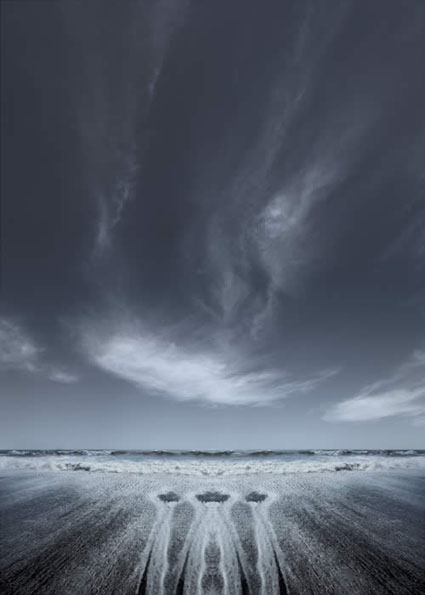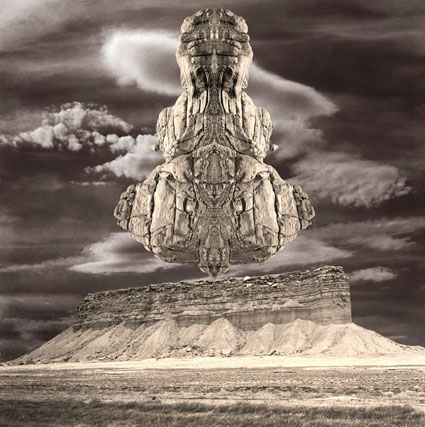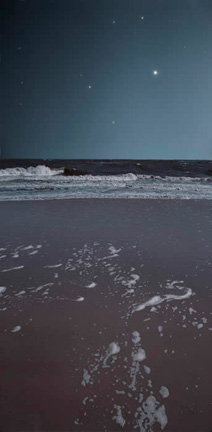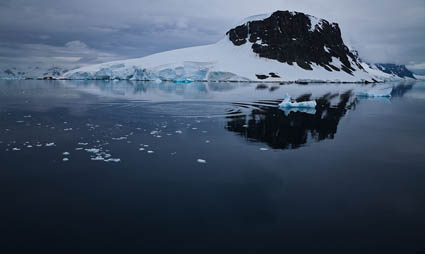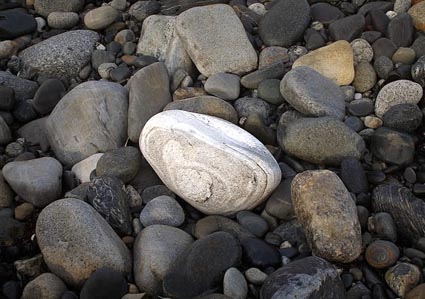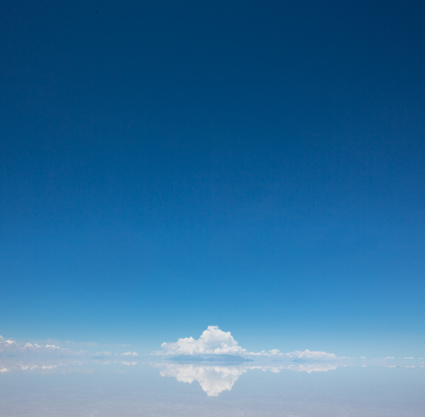
The patterns found in a majority of my images were created by nature. Yet the surfaces in these pictures are not untouched by me. I have influenced them all: by selection of moment; by choice of perspective; by use of tool; by inclusion and exclusion with the picture frame; by further eliminations from and additions to what remains within the picture frame; by changing proportion; by orchestrating color; by creating symmetries; etc. I consider all of these opportunities to collaborate with the hand of nature.

With growing frequency, traces of my physical presence are displayed in my images. Sometimes I set things on fire. Sometimes, I push and pull smoke with my breath. Sometimes, I toss ash in the air. At other times, I create ripples in water. In this case, the circles and trails in the receding foam were created by placing my feet in the pulsing surf.

I prefer that the marks I make in nature remain ephemeral. In this way, the next person who experiences the same location I was in, is free to experience it in their own ways. If we’re lucky, we may even be able to compare our experiences. The only durable mark I leave in my process is the photograph itself.

The impulse to acknowledge my involvement in every moment and create something beautiful from it, has been growing stronger and stronger within me.

View / read more here.

artistsstatements

It’s important to learn how to make the visual verbal, by crafting artist’s statements. Many artists feel that images are better seen and not heard. I understand their point of view. But, face it, things will be said and written about your images. If you don’t do it, someone else will. You might as well become involved in the process. After all, as the author, this is one arena where your words are definitive.

You don’t have to be a professional writer to write. Just write. Write like you speak. Write with your voice.

Like making images, writing is a process, a process of making thoughts and feelings clearer. Often, you don’t know what shape the final product will take, until you finish.

At first, I resisted writing about my images. Now, I find the process so valuable that I’ve made it a part of my artistic process. Every time a new body of work arises, I write. When I’m ready to release a book of the work, I write again. As a result of writing, I gain a better understanding of the work I did, the work I’m doing, and the work I’m going to do. So do the people who see my images, surprisingly, even if they don’t read what I write.

This is an excerpt from a longer essay Artists’ Statements. Download it here.

Read my artist’s statements here.

Read the text from three recent books here.

Learn more in my Fine Art Digital Printing Workshops.

Enjoy the text from my book Condensation.
.
Condensation
.
Light
.

All photographs are about light. The great majority of photographs record light as a way of describing objects in space. A few photographs are more about spaces they represent than the objects within those spaces. Still fewer photographs are about light itself.

Time, space, light. All the things this work is about are ultimately missing from the final product – the print. Put it in a dark room and there will still be no light. Touch it and you’ll find it’s flat. Consider it for an extended time; you’ll change but it won’t. Curiously, these conspicuous absences within the print make what’s missing more intensely felt. How does absence make something more clearly experienced? Perhaps it’s that the gap between representation and reality gives us pause and begs us to more carefully reconsider the world around us and the experiences we have in it, at first as a way of verification but later as a way of celebration. Read more

Enjoy the text from my book Correspondence.
.

Correspondence

The first thing I do when I walk outside is look up. The next thing I do is scan the horizon. Hopefully, there’s water nearby; no matter how active or still it is, I’m mesmerized by it. I’m always looking at the sky, the horizon, and water for information and inspiration. Sometimes I stare for hours. More often than not, just for seconds or minutes. I consider myself luckier the longer I look. I have no idea how much time I’ve spent gazing at these things, but I’m always rewarded – if not with an image, then with a new state of mind. That’s how these images were made, through the accumulation of a lot of looking. These images are meditations. They’re an invitation to look closely at looking. They’re an invitation to see more fully, more deeply, and in many ways. Read more

Enjoy the text from my book Reflection.
.
Reflection
.
Cloudwatching

What child hasn’t spent scattered minutes, accumulated into hours or even days, watching slowly unfolding clouds and the changing sky? Wondering what they were, are, and will be. Imagining bodies (either whole or in pieces, especially faces), animals (whether commonplace, exotic, or mythical), plants, landscapes, and even mechanical devices. Who doesn’t pause at the sight of the blazing colors of the morning and evening sky? How few pause long enough to see the stars begin to appear? How strange to think that the same sky is blue by day and black by night, studded with twinkling stars. Are we like this too? Why do so many adults cease to probe these mysteries as consistently and frequently and with as much curiosity as a child does? What do we lose when we lose the search? Read more

Budh

December 19, 2009 | 3 Comments

Budh_1996_5

“I didn’t know it then, but it was the beginning of a whole new series. I knew it after it began happening repeatedly. The process had led me to a new point of departure. The work was a surprise. I hadn’t planned on doing it. It came to me. I had planned to do another body of work, but this one seized me and asked me to stay with it while it was fresh. I listened. I have a feeling that if I had ignored that voice I would not have been able to return to it later, certainly not with the same intensity or understanding …”

Read the rest of this Artist’s Statement here.

Nocturne IV

October 24, 2009 | Leave a Comment

NocturneIV_1998

I’ve always been fascinated by photographs of the night sky. Telescopes are able to bring back details I could never have seen with the naked eye. Film exaggerates the colors of the stars, which are faint to the human eye. The lens often eliminates the tiny flares we see. When we draw stars, we don’t use circles, we usually use pentagrams. There’s a reason. I can understand that the twinkle and shimmer of the tapestries above would disappear in a photograph. Time is frozen in photographs. But that the photograph would be significantly different than what the human eye sees is fascinating to me. We’re taught to think that the camera records things as we see them. It does to a degree. But there are many points of divergence. It’s almost standard for us to defer to the photograph over our own experience. That’s something I’m wary of — or let’s say instead, acutely aware of …

Read more here.

Antarctica_2009-CVIII

A new online gallery at johnpaulcaponigro-antarctica.com features my comments on a recent image.

“I was on the Ocean Nova with four other teachers and about 75 students. We were coming up through the Neumayer Channel, a little more than halfway through our trip south of the Antarctic Circle. A whale moved past us …”

See them both here.

Solo

September 19, 2009 | Leave a Comment

” … The change from one moment to another was dramatic. Bright sun. Shadow. And, to my surprise, there was a beautiful quality of diffuse light when the sun was struck by the edges of each cloud. Some clouds were thicker than others. Every moment was different. I started to interact with the light. I used a white sheet as a diffuser, a large piece of foam core as a cool reflector, and a warm gold reflector. I played for hours, simply enjoying the light. I intended to come back with three exposures. I came back with dozens. In the end, I used two. But my understanding of light and my experience of light had completely changed from that moment forward. And, what I thought might be an isolated image turned out to be a whole series of images. Process is important when it informs the work; it becomes a part of the final product. Process is even more important when it informs you; it becomes a part of you. Fully engaging the process and the subject changed me. That changes the image. That changes what you see. That’s the chance we take as artists. We dare to be changed. It’s a chance well worth taking.”

Read more here.

Learn this technique in my field workshops.

Oriens I

August 29, 2009 | Leave a Comment

“Oriens represents a new line of inquiry for me. Take the most compelling passages of changing light throughout an extended duration of time and weave them into a single composition … Neither method, resynchronization or recontextualization, yields a classically objective document. But the results of either application may yield artifacts that are truer to our experience of events. In one respect these represent the events more faithfully — they encompass the passage of time.”

Read the rest of this Statement here.

Antarctica 2009

August 1, 2009 | Leave a Comment

“There is a profound sense of privilege that comes from being in the presence of such rare beauty. It touches you deeply. Witness to the extraordinary, you leave changed – for the better. It’s a blessing born of grace and giving birth to more grace. It’s as if you’ve been given a gift and you feel compelled to keep giving it.”

Read about the highlights from three voyages to Antarctica.
Each voyage was very different from the other, even though we returned to some of the same locations.

Get priority status in my Antarctica 2011 workshop.
Email info@johnpaulcaponigro.com.

Survivor

May 2, 2009 | Leave a Comment

“How much do you sacrifice? What’s best left included? What’s better left out? That sums up the whole photographic process for me. It’s about what survives and what doesn’t.

This image is like a poem. There’s a lyrical quality to it. There are echoes and rhymes within it. Though one is dark and one is light, the shape of the cloud is similar to the shape of the tree. The darkest and lightest values are linked through shape. The eye travels back and forth between the two. The common language found in their contours sets up a visual dialogue between the two. The image is bathed in a warm light, almost red, an appropriate color for both the earth and a heart. The limbs of the tree branch out contained within the body of stone, like veins. The image breathes. While there may be only a few visible signs at first, still, life persists, even in wastelands …”

Read the rest of this Statement here.

Read more Statements here.

Posse

April 25, 2009 | Leave a Comment

“The stunning presences, within the series Allies, reminiscent of Native American totem poles, African sculpture, or Hindu figurines, had been pursuing me for months. There were, and still are, dozens waiting to find homes. While the majority of the images I had created featured solitary figures, I was drawn to explore the effects of many within a single image — group dynamics …  Most leading actors need supporting actors, all save the soloist need accompaniment. But, when supporting actors compete with main actors, the thrust of the drama is confused …”

Read the rest of this statement here.
Read more statements here.

Triple Goddess

April 18, 2009 | Leave a Comment

Edge was critical throughout the entire process of composing Triple Goddess. First there was contour. What shape would the stone finally take? The original had been buried in sand. The stone was far too large to dig out, so I cut away the background that threatened to envelop it. This made certain determinations of shape. It may even have been the shape the sand made out of the stone that first attracted me to it. Had I seen the entire stone I might not have been so drawn to it. To date I have no idea what the full stone looks like, as I was only able to see a portion of it …

Read the rest here.

Read more statements and see more images here.

Oriental I

April 11, 2009 | Leave a Comment

“I have always been particularly attracted to Asian calligraphy and painting. Ancient oriental paintings rely on overlap and atmospheric perspective rather than linear perspective to depict the recession of space on a flat plane. I particularly like the way they treat morning or evening mist over mountains. One abstract shape precedes another, successively growing paler, and each is paler at the bottom and darker at the top. You can see the atmosphere …”

Read the rest of this statement here.

Read my other Artist’s Statements here.

July 18, 2003

“Many meditation practices suggest gazing at the flow of water, in some cases watching or visualizing a drop of water hit the still surface of a greater body of water. Like many mandalas, Resonance in Red and Gold has a rhythmic centering quality.

The methods of both photographer and painter are married here. The color is an invention. The composition, both representational and abstract, offers a fluid structure to explore the power of color, physically and psychologically.

Red, the warmest color. Is its presence here the reflected glory of the heavens, a display of bodily fluid, or an omen of toxic waste? The power of this image can be found, in part, in tantalizing ambiguity. When looking at this image, I’ve asked myself why red, time and time again. I can’t answer the question. But by asking the questions that surround it I learn to more fully appreciate the presence and power of red.”

Read other artist’s statements here.

Find out more about my workshop The Power of Color here.


-

Some images are better in black and white. This is one.

“Dangerous Passage was a compelling image. But something wasn’t working. The thorns were red. The stalks were green. The water was blue. They were not subtle. The color was garish. In many ways, the color was too literal. The drama of the composition was competing with the drama of color. The two were at odds. Their moods were incompatible. One was harsh and edgy. The other was bright and cheery. Color was the problem. So I removed it … The message was clarified. The image carried a much greater weight. Less became more. The image was somber in black and white. That much suited the mood. But it was ashen, cold, and remote. I missed the emotional power of color. So I put it back. I converted the image back to a color mode and introduced new color into the image.”

Read the rest of my artist’s statement here.
Read other artist’s statements here.

Find out more about black and white in my DVD Black & White Mastery.
Find out more about black and white in my Workshop Black & White Mastery.
Special discounts are available until January.

“They say we can’t see color at night. By comparison to day, I suppose that’s true. However, if there’s a significant amount of light, there are wonderful colors to be found at night.”

I wrote this many years ago. Since then I’ve come across recent scientific research that overturns the notion that we don’t see color at night. While our sensitivity to hue in low levels of light does diminish, we very definitely see it. We see color at night, even in the darkest hours.

Time and time again, throughout the history of art, I’ve seen examples of people calling it like they see it and expressing an underlying truth that science has yet to catch up with. My advice? Look closely. Trust your direct perception over the way you’ve been taught to see or think about seeing. Hold the questions of how it all works answered but open. With an open mind we learn more every day, There’s always more to learn.

See the rest of the statement here.

Read more statements here.

Like any art form, writing reveals new things every time you engage the process. You can use writing to explore dimensions in images that aren’t immediately obvious.
Here’s an excerpt from the first statement I wrote on Mandala in Silver & Gold. I later wrote a second. I think a third may be useful.

“Surprises often become the start of something new. I find they contain the seeds for a new series or a new subset of an existing series. A latent theme is suddenly made visible. Rosa Celestia is one of those images for me …
I’ve come to know more and more about this image the longer I have lived with it. Yet it still remains a mystery. The fact that I can’t explain it, yet it still moves me, tells me the work is alive. I continue to look and be fascinated by it. I see more every time I return to it. It has become a well to draw from.”

Read two statements on one image here and here.

Writing about your work can often be a rewarding experience. It can reveal themes that might not be obvious at first glance. When it’s really working there’s as much discovery for the writer and the reader. Here’s an excerpt from a statement I wrote for my book Adobe Photoshop Master Class.

“Photographs are a kind of memory. Photographs are representations of memories. Often we don’t realize how important the memories of their makers are in establishing our relationships to them. Part of their authenticity is derived from the testimony of the witnesses who made them. It’s that testimony that would stand up in a court of law more strongly than the data in the document. Clearly the two are inextricably linked. When a photograph’s maker is gone, what happens to that testimony? How often do we presume too much?
This photograph is a representation of a memory and a feeling. While it is part fact, it is also part fiction. It is only partially objective; it is clearly subjective. Though it may not be as clearly stated in many photographs as it is here, I think most photographs are. The larger metaphor this image portrays — “as above, so below,” once latent now overt — suggests a relationship that cannot be grasped from one vantage point at one moment in time. It can only be found in the comparison of many memories — some above, some below, some by day, some by night.”

Read the rest of the statement here.

Read more of my statements here.

keep looking »

Subscribe

Get the RSS Feed  

Subscribe by Email


    Categories

  • Archives

  • Blogroll

    Topics & Friends