

Simultaneous Contrast
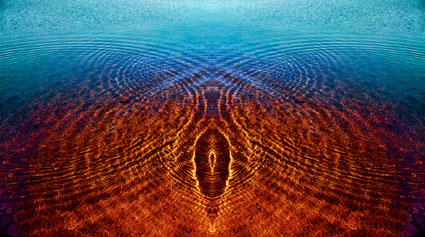
How red is red? That depends in part on its context. We see colors in relationship to other colors in our field of vision. The appearance of any one color is modified by the presence of other colors. (This is a perceptual effect, not a physical effect; while we experience it, we cannot measure it physically.)
Once you identify the elements in play, you can predict the effect. Simultaneous contrast can occur between any one or multiple components of the three elements of color – luminosity, hue, or saturation.
Place dark colors next to light colors and the dark colors will appear darker and the light colors will appear lighter.
Place cool colors next to warm colors and the cool colors will appear cooler while the warm colors will appear warmer. (Additionally, complementary hues increase each other’s saturation.)
Place saturated colors next to less saturated colors and the desaturated colors will appear less saturated while the saturated colors will appear more saturated. (Additionally, the desaturated color will appear to contain a cast of the saturated hue’s complement.)
Want to make a color appear lighter? Make it lighter or make surrounding colors darker or both. Want to make a color appear warmer? Make it warmer or make surrounding colors cooler or both. Want to make a color appear more saturated? Make it more saturated or make surrounding colors less saturated or both.
Contrast (or lack thereof) is the engine that drives color dynamics. To intensify a visual effect, increase the contrast in the appropriate components of color. This effect is intensified between adjacent colors. It is further intensified if one color surrounds another, partially or entirely. (If a color dynamic is particularly intense it may create the visual appearance of a line separating the two fields of color. Op artists often use these effects to create highly dynamic visual effects that appear to pulsate or move.)
Color management doesn’t yet accommodate these kinds of perceptual effects. Standard color correction strategies don’t tend to address them. But you can incorporate them into your color adjustment methods for greater precision and/or expression. All you need to do is take note of them and make appropriate compensations to achieve the result you desire.

Surround a color with a lighter color and it will appear darker.
Surround a color with a darker color and it will appear lighter.
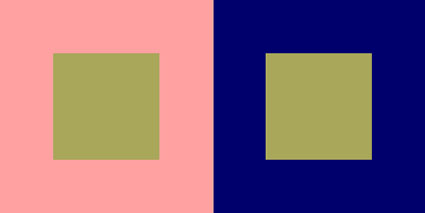
Surround a color with different hues and its will shift in appearance towards the complementary hue of the surrounding color.
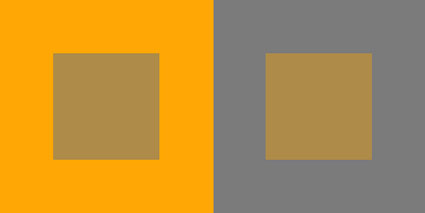
Surround a color with a less saturated color and it will appear more saturated.
Surround a color with a more saturated color and it will appear less saturated.
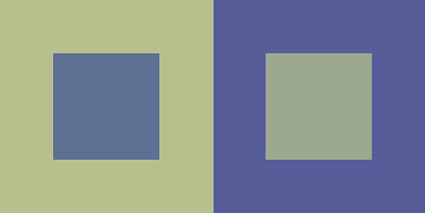
You can surround two different colors with two other colors to make them appear the same.
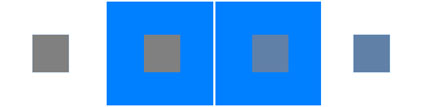
When a truly neutral color is surrounded by a saturated hue it no longer appears truly neutral. To achieve a neutral appearance the hue of the neutral color needs to be adjusted away from neutral towards the surrounding color.
Understanding the dynamics of simultaneous contrast will help you see, identify, choose, and adjust color relationships more precisely.
Exercise
1 Make one color appear to be of different luminosities by surrounding it with appropriate colors.
2 Make one color appear to be of different hues by surrounding it with appropriate colors.
3 Make one color appear to be of different saturations by surrounding it with appropriate colors.
4 Make one color appear to be two colors by surrounding it with appropriate colors.
5 Make two different colors appear the same by surrounding them with appropriate colors.
Because it’s difficult to separate other forms of image content from color, color exercises are best performed abstractly. While it’s useful to check numerical values for colors and color relationships, because these exercises are perceptual (often incorporating physiological and psychological responses that are not physically measurable), determine your answers visually. Train and trust your eye.
Read more Color Theory.
Learn more in my digital photography and digital printing workshops.
Judith Bunt
02.02.2019 at 11:03Since photography is using light (mixture of which is subtractive) not paint (additive)…how does this affect the simultaneous contrast phenomena?
John Paul Caponigro
02.02.2019 at 12:14Simultaneous contrast is an optical illusion produced by your eyes. It apoears when you see color from any source but it’s not measurable in the external world.