The Essential Collection of Documentaries On Photographers Online
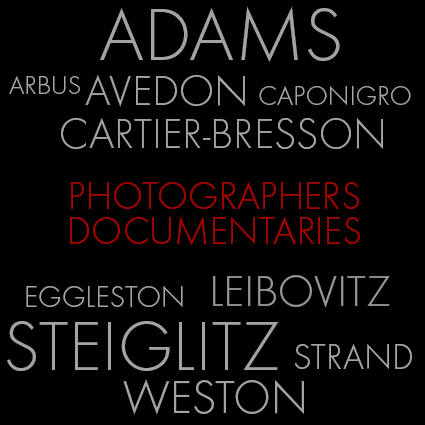
PhotoDocumentaries3
It’s insightful to learn about and from the photographers who make the classic photographs.
Here’s a collection of videos on photographers that I’ve enjoyed most.
You’ll find them inspiring!
Where do I recommend you start? With the classics – in red.
Sam Abell | View 
Ansel Adams | View 1 | View 2 | View 3
Robert Adams | View
Diane Arbus| View

Richard Avedon | View

James Balog | View 1 | View 2 | View 3

Ruth Bernhard View
Yann Arthus-Bertrand | View
Phil Borges | View
Bill Brandt | View
Edward Burtinsky | View
John Paul Caponigro | View

Paul Caponigro | View

Harry Callahan | View
Henri Cartier-Bresson  | View 1 | View 2  | View 3  | View 4  | View 5
Chuck Close| View
Anton Corbijn | View
Gregory Crewdson| View
Bruce Davidson | View
William Eggleston | View 1 | View 2

Alfred Eisendstaedt | View
Walker Evans | View
Andreas Feininger | View
Robert Frank | View
Ralph Gibson | View
Laura Gilpin | View

Nan Goldin | View
Emmet Gowin | View
Gregory Heisler | View 1 View 2
David Hockney | View 1 | View 2

Chris James | Coming Soon
Bill Jay | View
Chris Jordan | View
Michael Kenna | View

Sean Kernan | View
Andre Kertesz | View
David LaChapelle | View

Frans Lanting | View
Jacques-Henri Lartigue | View
Annie Leibovitz | View 1 View 2

Jay Maisel | View
Sally Mann | View 1 | View 2 | View 3

Arthur Meyerson | View
Duane Michals | View 1  | View 2

Mary Ellen Mark | View
Steve McCurry | View
Joe McNally | View
Joel Meyerowitz | View
Richard Misrach |  View
Tina Modotti | View

Sarah Moon | View
Edward Muybridge | View
James Nachtwey | View
Arnold Newman | View
Helmut Newton | View

Gordon Parks| View
Martin Parr | View
Eliot Porter | View

Chris Rainier | Coming
Eugene Richards | View
Sebastiao Salgado | View 1 | View 2

John Sexton | View 1 | View 2

Cindy Sherman | View
Stephen Shore | View
Aaron Siskind | View
Eugene Smith | View
Rick Smolan | View
Fredrick Sommer | View
Edward Steichen | View

Alfred Stieglitz | View

Paul Strand | View

Hiroshi Sugimoto | View
Joyce Tenneson | View
George Tice | View
Pete Turner | View

Jerry Uelsmann | View

Nick Veasey | View
Jeff Wall | View
Andy Warhol View
Weegee | View
Edward Weston | View

Kim Weston | View

Garry Winogrand | View
Dan Winters | View
Huntington Witherill | View 1 | View 2

Art Wolfe | View

View new additions to this collection here.
Read The Essential Collection Of Photographer’s Quotes here.
Read my conversations Photographers On Photography here.
12 Quotes By Photographer Robert Frank

 
Here’s a selection of my favorite quotes by photographer Robert Frank.
“The eye should learn to listen before it looks.” ― Robert Frank
“When people look at my pictures I want them to feel the way they do when they want to read a line of a poem twice.”
― Robert Frank
“A message picture is something that’s simply too clear.” – Robert Frank
“To produce an authentic contemporary document, the visual impact should be such as will nullify explanation.” – Robert Frank
“Black and white are the colors of photography. To me they symbolize the alternatives of hope and despair to which mankind is forever subjected.” – Robert Frank
“I am always looking outside, trying to say something that is true. But maybe nothing is really true. Except what’s out there. And what’s out there is constantly changing.”
― Robert Frank
“There is one thing the photograph must contain, the humanity of the moment. This kind of photography is realism. But realism is not enough – there has to be vision, and the two together can make a good photograph.” – Robert Frank
“I have been frequently accused of deliberately twisting subject matter to my point of view. Opinion often consists of a kind of criticism. But criticism can come out of love.” – Robert Frank
“I always say that I don’t want to be sentimental, that the photographs shouldn’t be sentimental, and yet, I am conscious of my sentimentality.” – Robert Frank
“It is always the instantaneous reaction to oneself that produces a photograph.” – Robert Frank
“My photographs are not planned or composed in advance, and I do not anticipate that the onlooker will share my viewpoint. However, I feel that if my photograph leaves an image on his mind, something has been accomplished.” – Robert Frank
“Above all, life for a photographer cannot be a matter of indifference” ― Robert Frank
Read more Photographer’s Quotes here.

22 Quotes By Photographer David LaChapelle

 
Here’s a selection of quotes by photographer David LaChapelle.
“I believe in a visual language that should be as strong as the written word.” – David LaChapelle
“I was always painting when I was a kid. But then when I handled a camera when I was 17, that was it for me. I loved photography. I would work 4 or 5 hours a day. It was like a calling.” – David LaChapelle
“I went to art high school and thought I’d be a painter. Unfortunately I didn’t finish high school, but that’s always been part of my work.” – David LaChapelle
“I’m a photographer, period. I love photography, the immediacy of it. I like the craft, the idea of saying ‘I’m a photographer.” – David LaChapelle
“People say photographs don’t lie, mine do.” – David LaChapelle
“I didn’t see any difference between being a photographer or being an artist. I didn’t make those boundaries. If someone wants to think it’s art, that’s great, but I’ll let history decide.” – David LaChapelle
“Then I got this idea in my head that magazines were like a gallery and if you got your magazine page ripped out and someone stuck it on their refrigerator, then that was a museum – someone’s private museum.” – David LaChapelle
“You just do what you love, and then a style happens later on.” – David LaChapelle
“I was working in this very bombastic style. I didn’t really know about style. I didn’t think about it: I did what I was interested in, what I was attracted to, what I was drawn to. I was drawn to color, and I was drawn to humor, and I was drawn to sexuality and spontaneity. It was all really intuitive. I never really thought, “Well this is the style…” – David LaChapelle
“I wanted it to provide an escape route, I wanted to make pictures that were fantastic and took you into another world, one that was brighter. I started off with this idea.” – David LaChapelle
“For me, it’s easier to like more things than to dislike them; I’m not a critic in that sense. I find it easier to like more, to be more open and enjoy more things, which has given me more opportunities.” – David LaChapelle
“I never want people to be repulsed with my pictures; I always want to attract people.” – David LaChapelle
“Just as Renaissance artists provided narratives for the era they lived in, so do I. I’m always looking beyond the surface. I’ve done that ever since I first picked up a camera.” – David LaChapelle
“In the fashion world, I was always an outsider, but I made people look good, so I had a career.” – David LaChapelle
“My idea was that if I took a picture of somebody and years later, or whenever, they would die and if someone wanted to know who this person was, they could take one of these pictures and it would tell who the person was.” – David LaChapelle
“I have this idea that you can use glamour and still have it represent something that matters.” – David LaChapelle
“The tools I learned photographing celebrities, now I want to use them to sell ideas.” – David LaChapelle
“The adornment of the body is a human need. I don’t see anything superficial about it unless your life becomes very materialistic.” – David LaChapelle
“I like thinking about the fragility of the human flesh and our bodies – our decay and eventual death.” – David LaChapelle
“It’s much harder to work for yourself, by yourself, than to create work for a gallery, because there are no limits and you can do anything you want. It’s always easier when you have a parameter, when you have a limit. You can work within the limit and push it and walk the line, but when you’re given absolutely no limits, it’s harder. You must really think. It’s more challenging.” – David LaChapelle
“I’ve never wanted to be part of an inner circle of any scene. I’ve always been an outsider looking to question and subvert.” – David LaChapelle
“Success to me is being a good person, treating people well.” – David LaChapelle
Visit David LaChapelle’s website here.
View 12 Great Photographs By David La Chapelle.
View video about David LaChapelle here.
Read more Photographer’s Quotes here.

22 Quotes By Photographer Richard Avedon

 
Here’s a selection of my favorite quotes by photographer Richard Avedon.
“I hate cameras. They interfere, they’re always in the way. I wish: if I could just work with my eyes alone.” – Richard Avedon
“I believe that you’ve got to love your work so much that it is all you want to do.” – Richard Avedon
“And if a day goes by without my doing something related to photography, it’s as though I’ve neglected something essential to my existence, as though I had forgotten to wake up. I know that the accident of my being a photographer has made my life possible.” – Richard Avedon
“I think all art is about control – the encounter between control and the uncontrollable.” – Richard Avedon
“Anything is an art if you do it at the level of an art.” – Richard Avedon
“Camera lies all the time. It’s all it does is lie, because when you choose this moment instead of this moment, when you… the moment you’ve made a choice, you’re lying about something larger. ‘Lying’ is an ugly word. I don’t mean lying. But any artist picks and chooses what they want to paint or write about or say. Photographers are the same.” – Richard Avedon
“There is no such thing as inaccuracy in a photograph. All photographs are accurate. None of them is the truth.” – Richard Avedon
“It’s in trying to direct the traffic between Artiface [sic] and Candor, without being run over, that I’m confronted with the questions about photography that matter most to me.” – Richard Avedon
“I’ve worked out of a series of no’s. No to exquisite light, no to apparent compositions, no to the seduction of poses or narrative. And all these no’s force me to the “yes.” I have a white background. I have the person I’m interested in and the thing that happens between us.” – Richard Avedon
“My photographs don’t go below the surface. They don’t go below anything. They’re readings of the surface. I have great faith in surfaces. A good one is full of clues.” – Richard Avedon
“All photographs are accurate. None of them is the truth.” – Richard Avedon
“The moment an emotion or fact is transformed into a photograph it is no longer a fact but an opinion ….” – Richard Avedon
“There’s always been a separation between fashion and what I call my “deeper” work. Fashion is where I make my living. I’m not knocking it. It’s a pleasure to make a living that way. It’s pleasure, and then there’s the deeper pleasure of doing my portraits. It’s not important what I consider myself to be, but I consider myself to be a portrait photographer.” – Richard Avedon
“Whenever I become absorbed in the beauty of a face, in the excellence of a single feature, I feel I’ve lost what’s really there…been seduced by someone else’s standard of beauty or by the sitter’s own idea of the best in him. That’s not usually the best. So each sitting becomes a contest.” – Richard Avedon
“The pictures have a reality for me that the people don’t. It is through the photographs that I know them.” – Richard Avedon
“I am always stimulated by people. Almost never by ideas.” – Richard Avedon
“A portrait photographer depends upon another person to complete his picture. The subject imagined, which in a sense is me, must be discovered in someone else willing to take part in a fiction he cannot possibly know about.” – Richard Avedon
“A photographic portrait is a picture of someone who knows he’s being photographed, and what he does with this knowledge is as much a part of the photograph as what he’s wearing or how he looks. He’s implicated in what’s happened, and he has a certain real power over the result.” – Richard Avedon
“Snapshots that have been taken of me working show something I was not aware of at all, that over and over again I’m holding my own body or my own hands exactly like the person I’m photographing. I never knew I did that, and obviously what I’m doing is trying to feel, actually physically feel, the way he or she feels at the moment I’m photographing them in order to deepen the sense of connection.” – Richard Avedon
“If each photograph steals a bit of the soul, isn’t it possible that I give up pieces of mine every time I take a picture?” – Richard Avedon
“My portraits are more about me than they are about the people I photograph.” – Richard Avedon
“Sometimes I think all my pictures are just pictures of me. My concern is … the human predicament; only what I consider the human predicament may simply be my own.” – Richard Avedon
Read more Photographer’s Quotes here.

30 Quotes By Photographer Diane Arbus

 
Here’s a selection of quotes by photographer Diane Arbus.
“The camera is a kind of license.” – Diane Arbus
“Photography was a licence to go whenever I wanted and to do what I wanted to do.” – Diane Arbus
“My favorite thing is to go where I’ve never been.” – Diane Arbus
“A photograph is a secret about a secret. The more it tells you the less you know.” – Diane Arbus
“Lately I’ve been struck with how I really love what you can’t see in a photograph.” – Diane Arbus
“I always thought of photography as a naughty thing to do — that was one of my favorite things about it, and when I first did it, I felt very perverse.” – Diane Arbus
“I think the most beautiful inventions are the ones you don’t think of.” – Diane Arbus
“The thing that’s important to know is that you never know. You’re always sort of feeling your way.” – Diane Arbus
“One thing that struck me very early is that you don’t put into a photograph what’s going to come out. Or, vice versa, what comes out is not what you put in.” – Diane Arbus
“I never have taken a picture I’ve intended. They’re always better or worse.” – Diane Arbus
“Some pictures are tentative forays without your even knowing it. They become methods. It’s important to take bad pictures. It’s the bad ones that have to do with what you’ve never done before. They can make you recognize something you hadn’t seen in a way that will make you recognize it when you see it again.” – Diane Arbus
“What moves me about…what’s called technique…is that it comes from some mysterious deep place. I mean it can have something to do with the paper and the developer and all that stuff, but it comes mostly from some very deep choices somebody has made that take a long time and keep haunting them.” – Diane Arbus
“I used to have this notion when I was a kid that the minute you said anything, it was no longer true. Of course it would have driven me crazy very rapidly if I hadn’t dropped it, but there’s something similar in what I’m trying to say. That once it’s been done, you want to go someplace else. There’s just some sense of straining.” – Diane Arbus
“The Chinese have a theory that you pass through boredom into fascination and I think it’s true. I would never choose a subject for what it means to me or what I think about it. You’ve just got to choose a subject – and what you feel about it, what it means, begins to unfold if you just plain choose a subject and do it enough.” – Diane Arbus
“I’m very little drawn to photographing people that are known or even subjects that are known. They fascinate me when I’ve barely heard of them.” – Diane Arbus“I work from awkwardness. By that I mean I don’t like to arrange things. If I stand in front of something, instead of arranging it, I arrange myself.” – Diane Arbus
“What I’m trying to describe is that it’s impossible to get out of your skin into somebody else’s…. That somebody else’s tragedy is not the same as your own.” ― Diane Arbus
“I don’t know what good composition is…. Sometimes for me composition has to do with a certain brightness or a certain coming to restness and other times it has to do with funny mistakes. There’s a kind of rightness and wrongness and sometimes I like rightness and sometimes I like wrongness.” – Diane Arbus
“The camera is cruel, so I try to be as good as I can to make things even.” – Diane Arbus
“For me the subject of a picture is always more important than the picture. And more complicated.” – Diane Arbus
“I would never choose a subject for what it means to me. I choose a subject and then what I feel about it, what it means, begins to unfold.” – Diane Arbus
“Take pictures of what you fear.” – Diane Arbus
“The more specific you are, the more general it’ll be.” – Diane Arbus
“Everybody has that thing where they need to look one way but they come out looking another way and that’s what people observe.” – Diane Arbus
“Nothing is easier than self-deceit. For what each man wishes, that he also believes to be true.” – Diane Arbus
“There’s a kind of power thing about the camera. I mean everyone knows you’ve got some edge. You’re carrying some magic which does something to them. It fixes them in a way.” – Diane Arbus
“It’s always seemed to me that photography tends to deal with facts whereas film tends to deal with fiction.” – Diane Arbus
“Love involves a peculiar unfathomable combination of understanding and misunderstanding.” – Diane Arbus
“The world can only be grasped by action, not by contemplation. The hand is the cutting edge of the mind.” – Diane Arbus
“If you scrutinize reality closely enough, if in some way you really, really get to it, it becomes fantastic.” ― Diane Arbus
“I really believe there are things nobody would see if I didn’t photograph them.” – Diane Arbus
Read more Photographer’s Quotes here.

19 Quotes By Photographer William Eggleston

 
Here’s a selection of quotes by phot0grapher William Eggleston.
“I am at war with the obvious.” – William Eggelston
“You can take a good picture of anything. A bad one, too.” – William Eggelston
“I had this notion of what I called a democratic way of looking around, that nothing was more or less important.” – William Eggelston
“It quickly came to be that I grew interested in photographing whatever was there wherever I happened to be. For any reason.” – William Eggelston
” Whatever it is about pictures, photographs, it’s just about impossible to follow up with words. They don’t have anything to do with each other.” – William Eggelston
“I want to make a picture that could stand on its own, regardless of what it was a picture of. I’ve never been a bit interested in the fact that this was a picture of a blues musician or a street corner or something. ” – William Eggelston
“I only ever take one picture of one thing. Literally. Never two. So then that picture is taken and then the next one is waiting somewhere else.” – William Eggelston
“I don’t have a burning desire to go out and document anything. It just happens when it happens. It’s not a conscious effort, nor is it a struggle. Wouldn’t do it if it was. The idea of the suffering artist has never appealed to me. Being here is suffering enough.” – William Eggelston
“There is no particular reason to search for meaning.” – William Eggelston
“A picture is what it is and I’ve never noticed that it helps to talk about them, or answer specific questions about them, much less volunteer information in words. It wouldn’t make any sense to explain them. Kind of diminishes them. People always want to know when something was taken, where it was taken, and, God knows, why it was taken. It gets really ridiculous. I mean, they’re right there, whatever they are.” – William Eggelston
“I never know beforehand. Until I see it. It just happens all at once. I take a picture very quickly and instantly forget about it.” – William Eggelston
” I don’t really look at other people’s photographs at all. It takes enough time to look at my own.” – William Eggelston
” I don’t have favorites. I look at pictures democratically. To me they are all equal. ” – William Eggelston
” I just wait until [my subject] appears, which is often where I happen to be. Might be something right across the street. Might be something on down the road. And I’m usually very pleased when I get the image back. It’s usually exactly what I saw. I don’t have any favorites. Every picture is equal but different.” – William Eggelston
“I am afraid that there are more people than I can imagine who can go no further than appreciating a picture that is a rectangle with an object in the middle of it, which they can identify. ” – William Eggelston
“I’ve always assumed that the abstract qualities of [my] photographs are obvious. For instance, I can turn them upside down and they’re still interesting to me as pictures. If you turn a picture that’s not well organized upside down, it won’t work.” – William Eggelston
“Whether a photo or music, or a drawing or anything else I might do—it’s ultimately all an abstraction of my peculiar experience.” – William Eggelston
“You become technically proficient whether you want to or not, the more you take pictures.” – William Eggelston
“Photography just gets us out of the house.” – William Eggelston
Read more Photographer’s Quotes here.

24 Quotes By Photographer Ernst Haas

 
Here’s a selection of my favorite quotes by photographer Ernst Haas.
“With photography a new language has been created. Now for the first time it is possible to express reality by reality. We can look at an impression as long as we wish, we can delve into it and, so to speak, renew past experiences at will.” – Ernst Haas
“We can write the new chapters in a visual language whose prose and poetry will need no translation.” – Ernst Haas
“There are almost too many possibilities. Photography is in direct proportion with our time: multiple, faster, instant. Because it is so easy, it will be more difficult.” – Ernst Haas
“Living in a time of the increasing struggle of the mechanization of man, photography has become another example of this paradoxical problem of how to humanize, how to overcome a machine on which we are thoroughly dependent… the camera…” – Ernst Haas
“A few words about the question of whether photography is art or not: I never understood the question.” – Ernst Haas
“There are two kinds of photographers: those who compose pictures and those who take them. The former work in studios. For the latter, the studio is the world…. For them, the ordinary doesn’t exist: every thing in life is a source of nourishment.” – Ernst Haas
“The best pictures differentiate themselves by nuances…a tiny relationship – either a harmony or a disharmony – that creates a picture.” – Ernst Haas
“Best wide-angle lens? Two steps backward. Look for the ‘ah-ha’.” – Ernst Haas
“The most important lens you have is your legs.” – Ernst Haas
“The camera doesn’t make a bit of difference. All of them can record what you are seeing. But, you have to SEE.” – Ernst Haas
“The camera only facilitates the taking. The photographer must do the giving in order to transform and transcend ordinary reality. The problem is to transform without deforming. He must gain intensity in form and content by bringing a subjective order into an objective chaos.” – Ernst Haas
“You don’t take pictures; the good ones happen to you.” – Ernst Haas
“Learn by doing or even better unlearn by doing.” – Ernst Haas
“Don’t park… Arrival is the death of inspiration.” – Ernst Haas
“I am not interested in shooting new things – I am interested to see things new.” – Ernst Haas
“A picture is the expression of an impression. If the beautiful were not in us, how would we ever recognize it?” – Ernst Haas
“You become things, you become an atmosphere, and if you become it, which means you incorporate it within you, you can also give it back. You can put this feeling into a picture. A painter can do it. And a musician can do it and I think a photographer can do that too and that I would call the dreaming with open eyes.” – Ernst Haas
“There is only you and your camera. The limitations in your photography are in yourself, for what we see is what we are.” – Ernst Haas
“I want to be remembered much more for a total vision than for a few perfect single pictures.” – Ernst Haas
“I prefer to be noticed some day, first for my ideas and second for my good eye…” – Ernst Haas
“Only a vision – that is what one must have.” – Ernst Haas
“Style has no formula, but it has a secret key. It is the extension of your personality. The summation of this indefinable net of your feeling, knowledge and experience.” – Ernst Haas
“In every artist there is poetry. In every human being there is the poetic element. We know, we feel, we believe.” – Ernst Haas
“Every work of art has its necessity; find out your very own. Ask yourself if you would do it if nobody would ever see it, if you would never be compensated for it, if nobody ever wanted it. If you come to a clear ‘yes’ in spite of it, then go ahead and don’t doubt it anymore.” – Ernst Haas
Read more photographer’s quotes here.
View photographer’s favorite quotes here.

22 Quotes By Photographer Minor White

 
Here’s a selection of my favorite quotes by Minor White.
“Photography is a language more universal than words.” – Minor White
“At first glance a photograph can inform us. At second glance it can reach us.” – Minor White
“There’s no particular class of photograph that I think is any better than any other class. I’m always and forever looking for the image that has spirit! I don’t give a damn how it got made.” – Minor White
“A very receptive state of mind… not unlike a sheet of film itself – seemingly inert, yet so sensitive that a fraction of a second’s exposure conceives a life in it.” – Minor White
“…innocence of eye has a quality of its own. It means to see as a child sees, with freshness and acknowledgment of the wonder; it also means to see as an adult sees who has gone full circle and once again sees as a child – with freshness and an even deeper sense of wonder.” – Minor White
“Photographers who come up with power never get accused of imitating anyone else even though they photograph the same broom, same street, same portraits.” -Minor White
“The photographer projects himself into everything he sees, identifying himself with everything in order to know it and to feel it better.” – Minor White
“When I looked at things for what they are I was fool enough to persist in my folly and found that each photograph was a mirror of my Self.” – Minor White
“…all photographs are self-portraits.” – Minor White
“Be still with yourself until the object of your attention affirms your presence.” – Minor White
“No matter how slow the film, Spirit always stands still long enough for the photographer It has chosen.” – Minor White
“One should not only photograph things for what they are but for what else they are.” – Minor White
“While we cannot describe its appearance (the equivalent), we can define its function. When a photograph functions as an Equivalent we can say that at that moment, and for that person the photograph acts as a symbol or plays the role of a metaphor for something that is beyond the subject photographed.” – Minor White
“It is curious that I always want to group things, a series of sonnets, a series of photographs; whatever rationalizations appear, they originate in urges that are rarely satisfied with single images.” – Minor White
“To engage a sequence we keep in mind the photographs on either side of the one in our eye.” – Minor White
“In putting images together I become active, and excitement is of another order – synthesis overshadows analysis.” – Minor White
“Before he has seen the whole, how unusually perceptive and imaginative the person must be to evolve the entire sequence by meditating on its single, pair, or triplet of essential images.” – Minor White
“Reaching a ‘creative’ state of mind thru positive action is considered preferable to waiting for ‘inspiration’.” – Minor White
“I have often photographed when I am not in tune with nature but the photographs look as if I had been. So I conclude that something in nature says, ‘Come and take my photograph.’ So I do, regardless of how I feel.” – Minor White
“When gifts are given to me through my camera, I accept them graciously.” – Minor White
“I’m always mentally photographing everything as practice.” – Minor White
“We could teach photography as a way to make a living, and best of all, somehow to get students to experience for themselves photography as a way of life.” – Minor White 
Read more photographer’s quotes here.
View photographer’s favorite quotes here.

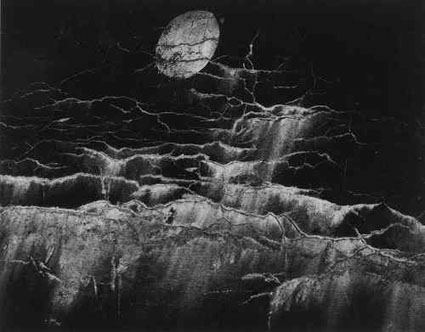
33 Quotes By Photographer John Paul Caponigro

ExhalationIV_2006_425
Here are my favorite quotes by photographer John Paul Caponigro.

“A good question has many answers.” – John Paul Caponigro

“It takes asking many questions from many perspectives to truly understand something.” – John Paul Caponigro

“Inquiry is more important than answers, for it is the questions we ask and the way in which we ask them that defines us.” – John Paul Caponigro

“How do we know what we know? Is seeing believing? Is believing seeing?” – John Paul Caponigro

“The most important question is, ‘Am I asking the most important question?’ The second most important question is, ‘Am I asking the most important question in the most important way?'” – John Paul Caponigro

“Don’t ask “‘Should I …?’. Instead, ‘Ask what happens if I …?'” – John Paul Caponigro

“Action tests ideas.” – John Paul Caponigro

“It’s one thing to record the appearance of something, it’s another to share what it truly means to you.” – John Paul Caponigro

“Capturing the light reflected off things is different than being captured by them.” – John Paul Caponigro

“Seen from one perspective, photography is much more about elimination than inclusion. The images we make with a lens typically eliminate eighty percent of our field of view and everything that is out of our field of view. The shutter slices time, eliminating all moments before and after it opens and closes. Three dimensions are reduced to two. And in some cases color is removed. Can we accurately call these kinds of artifacts unaltered? The act of creation is an alteration.” – John Paul Caponigro

“Every photograph is altered, to one degree or another.” – John Paul Caponigro

“Images are altered in many ways, to many degrees, and for many reasons, so it’s important for viewers to be informed of both.” – John Paul Caponigro

“It’s important that we regularly reconsider, revise, and expand our practices, as our capabilities and needs evolve, both to strengthen our understanding of them and to promote our awareness of new practices and their conscientious uses.” – John Paul Caponigro

“We don’t have enough words for photography. Can you imagine writers having only one word for writing?” – John Paul Caponigro

“Listen carefully. The way(s) we speak about things is revealing.” – John Paul Caponigro

“Many times we are tempted to defer to the documents we create, rather than the direct experiences we have.” – John Paul Caponigro

“Very often there is too little information in photographs to deduce how they were made and even what they represent. We rely on context and supplemental information to confirm our observations, not simply the documents themselves.” – John Paul Caponigro

“Different people can photograph the same things with the same tools and create such different images.” – John Paul Caponigro

“We are the strongest filter we can place on the lens. We always point the lens both outward and inward.” – John Paul Caponigro

“We’re responsible for everything that’s included in the frame. We’re also responsible for what’s not included in the frame. We’re responsible for the way we frame the world.” – John Paul Caponigro

“The frame frames a frame of mind.” – John Paul Caponigro

“We see the world through our experience.” – John Paul Caponigro

“Photography extends our perception allowing us to see and experience more – second hand.” – John Paul Caponigro

“Photographs are never records of the way things are; they’re records of the way things were.” – John Paul Caponigro

“Surfaces simultaneously reveal and conceal.” – John Paul Caponigro

“All photographs are about light. The great majority of photographs record light as a way of describing objects in space. A few photographs are less about objects and more about the space that contains them. Still fewer photographs are about light itself.” – John Paul Caponigro

“A photograph is an invitation to look – and to look at looking.” – John Paul Caponigro

“Many oriental cultures make a distinction between two ways of looking – ‘hard eyes’ and ‘soft eyes’. When we look with hard eyes, we see specific details with sharp focus, but we don’t see the relationships between different details as well. When we look with soft eyes we see the relationships between everything in our field of vision, but with this softer focus, we don’t see all the details as clearly. It’s possible to look in two ways at once.” – John Paul Caponigro

“Looking and seeing are two different things.” – John Paul Caponigro

“Seeing creates growth.” – John Paul Caponigro

“The best plans evolve.” – John Paul Caponigro

“We talk about the vulnerability involved in sharing our work publicly. I don’t think we talk enough about the real vulnerability involved in making art; if we truly engage the process we are changed by it.” – John Paul Caponigro

“Art is a journey of discovery.” – John Paul Caponigro

“Through the experience of art, the powers of perception and transformation can be awakened, in both those who create it and those who re-perceive it.” – John Paul Caponigro

“It’s one thing to make a beautiful thing; it’s another thing to make a living thing.” – John Paul Caponigro

“My mantra is, ‘This or something better.'” – John Paul Caponigro

Read our conversation here.
Read more photographer’s quotes here.