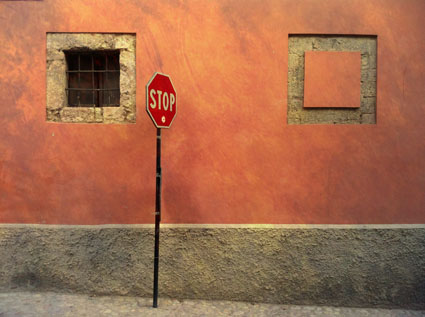
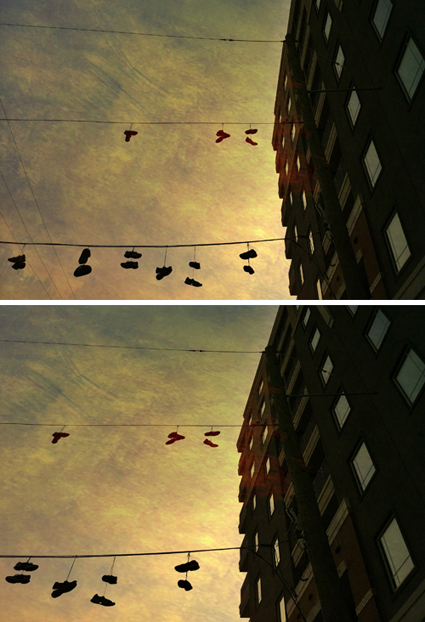
When you want to make a mobile phone image smaller quickly, launch iResize. Why would you want to change the size of an image? There are so many reasons; to email it, to post it online, and/or to share it in social networks are just a few. And with smart phone images growing in size every year, the need to do this is only increasing.

iResize can also change the proportion of an image from horizontal to panoramic, square, or even vertical.

iResize is one of those apps that you can learn instantly and is so easy to use that you’ll quickly overlook how often you use it, which is exactly what makes a go to app.

Read more with step-by-step illustrations on The Huffington Post.

Find iResize on iTunes.

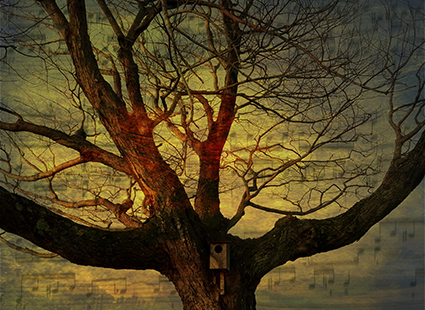
Combining images of music with other images has added a rich new dimension to my creative life and thinking. I don’t mean sequencing a soundtrack to a slideshow; I mean adding the graphic notation found in sheet music.

So that I can make these types of images on the spot, I’ve gathered a collection of photographs of music that I can draw on at a moment’s notice.

Doing this has not only yielded a growing number of compelling images, it has also raised a generative set of questions. In particular, the question of what’s missing or has been eliminated in still images and how that can be either more strongly felt or implied leads to many new ideas and insights.

I find that because I’m engaged in this experiment I notice the ambient sound of the places I’m photographing in more frequently and even photograph different things. My perception of the world becomes richer because I’m paying closer attention to it and to my responses to it.

What experiments will help you add a new or missing dimension to your images?

Read the full article on The Huffington Post.

Visit my iPhone learning center here.


The iPhone app Touch Retouch performs the kind of stunning magic that first appeared in Adobe Photoshop only a few years ago. Adobe introduced this type of instant retouching based on pattern recognition under the name of Content Aware Fill. Now a similar technology is available for smartphone photography. You can also use the Clone Stamp tool to copy specific information from one part of an image to another, either to cover over an unwanted element or duplicate it.

With a little practice, you’ll start seeing photographs that you once might have ignored or passed by because of minor imperfections, which can now be convincingly removed in instants with the tap of your fingers. (It’s great for filling in the gaps in panoramic stitches too.)
.
Read more about Touch Retouch on The Huffington Post.
.
Find more iPhone resources here.
.

Smart phone photography is a great way to stimulate your creativity and explore different ways of thinking visually. On a recent road trip I collected many images during moments in between events. I consider these experiments or sketches rather than finished images but the discoveries I make images more casually clearly inform the finished images I make. Simply playing visually helps me become more versatile. And it’s fun!

What role does smart phone photography play in your creative process?

Find my iPhone photography resources here.

Learn more in my digital photography and digital printing workshops.

You can use the app Liquid Scale to distort the frame of an image without distorting key elements in it. Like Adobe Photoshop’s Content Aware Scale, this software identifies image elements that are most likely to be more important than others and distorts other areas, typically areas that are smooth or randomly textured. There are limits to how far you can go before less distorted image elements begin to look unnatural, which are largely image dependent. In some cases, you can go so far as to convincingly turn a vertical image into a horizontal image. It’s magic.

This app will do more than change your images, it will change the way you see.

Read more and see more on The Huffington Post.

Plus find more app reviews.

As far as magic moments go, few can compare to those fleeting moments when light streams from the heavens or wraps around objects, as if making visible some some divine presence. Kings and priests would pay dearly for the ability to place such signs at their command. You can have it for the simple price of an app.

Rays identifies highlights within an image and uses them as sources to render rays of light from …

Read more here.

Plus find more app reviews.

When it comes to photography, you can do a lot with a little light. Adding light into your images offers many creative possibilities: add a sparkle to someone’s eyes, make highlights shine, enhance an atmospheric effect, trace a constellation in the sky, render a cinematic special effect, and much, much more. In short, you can enhance the center of attention in any image or create a new one.

Adding light into your photographs after exposure just got easier on your iPhone. Brain Fever Media makes two apps that can add light fx to your images: Lens Flare and Lens Light.

Lens Flare offers 45 different effects — mostly star patterns, some edge flares, and a few linear streaks.

Lens Light offers 54 different effects including rays, spotlights, streaks, scratches, and even suns, moons, and lightning.

Read more on The Huffington Post.

You’ll find a virtual pin-up board with links to 32 iphone photo apps I use regularly on Pinterest.

Find it here.

Read more about cell phone photography on the Huffington Post.

Do you ever wish you could reduce the intensity of an effect? Do you ever wish you could combine the effects of multiple Apps with more control? You can, with the App Image Blender.

Image Blender is extremely quick and easy to use. Simply launch Image Blender, load one version of an image and then load another version of the same image (or another image). To reduce an effect, use the opacity slider. To modify the way an effect is applied to an image, change the blend mode of one image and change the combined effect. To rotate or scale an image double tap on the screen, then pinch and twirl to align one image with another. Finally, save a new image with the combined effect of your choice.

Blend Modes

Blend modes can be used to generate many creative effects. Image Blender offers most of the standard blend modes; Normal (for no special effect), Lighten and Screen (to lighten), Darken and Multiply (to darken), Overlay and Soft Light and Hard Light (for contrast effects), Luminosity and Hue and Saturation and Color  (for color effects), Color Dodge and Color Burn (for combined contrast and color effects), Difference and Exclusion (for special effects), and two others Plus Darker and Plus Lighter (with self-explanatory titles).

Image Blender Provides Global Not Selective Control

Image Blender doesn’t allow you to blend images selectively with masks – i.e. in or not in one spot or from side to side or top to bottom. (To do this try PhotoForge 2.) In some cases, you can achieve similar effects by photographing subjects on black or white or painting areas of an image black or white and using blend modes like Darken or Lighten to drop out either the darkest or lightest values.

Multiple Exposures

Image Blender can be used to combine two different images. When you create multiple exposures with Image Blender a few strategies are particularly useful for creating multiple exposures with Image Blender. One, make exposures that have the same background but contain moving objects for futurist motion and/or ghostly transparent effects; keep your camera still; consider using a tripod. Two, use images that have dark objects on a light background or light objects on a dark background; you can make background lighter or darker by processing them with other Apps; then you can use the blend modes Lighten or Darken to make the background disappear.

Creative Enhancements

There are many things you can do to creatively enhance an image by modifying App effects. Here are six.

1         Partially restore the original state of an image.

2         Modify the way an effect adjusts an image.

3         Overlay text or graphics onto an image.

4         Add a transparent texture to an image.

5         Make moving objects transparent.

6         Merge two images into a surreal composite

Isn’t it nice to know that when it comes to the effects Apps have on your image, it’s not an all or nothing take it or leave it proposition? You can get more control, with Image Blender.

Find Image Blender here.

Find more iPhone app reviews on the Huffington Post.


Find out how to change your iPhone images from this to this or even this in less than a minute.

Splatter, speckle, and stain your images in seconds with the iPhone app Goth Pix. It generates surprisingly rich and complex weathering effects that can give your images an antique, distressed, or painterly look …

Read / View more on The Huffington Post.

Recently, during an African safari, I spent several days photographing animals. We saw all of the big five (lion, leopard, elephant, rhino, cape buffalo) and many other animals in one day. It was the first time I made a concerted effort to make wildlife photographs, which was excellent practice. I gained an increased appreciation for how moments of peak action (or lack thereof) can make or break some photographs. I made many competent photographs that entertained my family at home, which I have no intention of using professionally.

In between these sessions, I spent a few hours photographing the skulls of animals displayed in the camp. Initially, I photographed very freely, exploring many ways of photographing them. As I reviewed the images, I learned from both the successes and the failures, gradually refining my the point of view of the collection. I appreciate the images that go beyond direct representation and become suggestive of something more through abstraction and metaphor. Ultimately, these images, which I consider sketches, will lead to final results, which will result in professional products.

Unexpectedly, I found that these sessions helped me develop my thinking on how to incorporate the process of sketching, both with words, drawings and photographs, into the development and presentation of future professional work. In the right contexts, I might even publish, display or sell select sketches.

This session also helped me explore longstanding personal themes within my life and work. These images expand my understanding of the power of photography to transform our perceptions of a subject through close observation. They highlight for me the limitations of vision (and photography) to see beneath or beyond surfaces. They confirm how I frequently try to suggest the often unseen foundations of the things I photograph. They remind me of how much I love to draw bones, especially the human skeleton. They reinforce my longstanding desire to create sculptures, many influenced by these forms. They resurface my artistic influences; in particular Georgia O’Keefe and Henry Moore. I’m sure there are other valuable resources I can mine from this experience, if I give both the process and these results further thought.

Explorations often have many unintended consequences; often these become the discoveries we’re looking for when we engage in experiments. You’ll learn more from simply observing your creative process, without judgment, than from anything else. Awareness is everything. What makes a process of experimentation even more successful, richer and more relevant is subsequently reviewing our results and continually refining our lines of inquiry.

How could experimentation help you reveal, connect with and develop your influences?

What experiments would be most helpful to you?

These images were made in Mala Mala, South Africa during my recent South Africa Photo Safari (sponsored by NIK).

Apps used were PicGrunger and Snapseed.

See more images and find more posts on The Huffington Post.

Wow! Cool! Amazing! Fantastic! Beautiful! Great image! I love it! You can feel the love online — on Facebook, Twitter, Google+, Flickr, Picasa, Instagram, 500pix, BestCamera, and countless other image-sharing services, social networks, blogs, and websites. It feels good to give and receive praise. It can be motivating!

Ask For It

Do you want more love? Ask for it! There’s an implicit request for feedback when you post an image online, where people can comment on what you post. But, when you post images without a request for feedback, the number of responses you get goes down. Without an invitation, people may be hesitant to give you feedback. Or, they may not know how far to go and end up not going far as you’d like them to. So, if you’re looking for feedback when you post your work — ask for it. You’ll find people are quite happy to share their opinions with you.

Be More Specific

Love may not be the only thing you’re looking for. If you’re looking for more than love, there are many ways to find it. The way you ask for feedback can make a big difference in the kind of responses you get and how useful they are. If you don’t make a specific request, the responses you get will be general and unfocussed. Conversely, you can qualify the type of feedback you’re giving someone. State your approach before giving your feedback.

Ways To Give Feedback

There are as many ways to direct the kind of feedback you get as there are ways to give feedback. Here’s a list of eleven different kinds of feedback and ways to ask for it. You can ask the questions of either single images or groups of images. (You can even use this list to easily copy and paste questions when you post images online. Or make your own!) …

Read my full post on The Huffington Post.

Read more related posts on cell phone photography on The Huffington Post.

Finding it hard to choose between so many photo editing iPhone apps? Here’s my short list of essential photo editing apps. Get these ten apps and it’s likely you’ll only buy other apps for specialized effects or participating in specific social networks.

Snapseed, PhotoForge 2, Pro HDR, Auto Stitch Panorama, Liquid Scale, iResize, Photo Fixer, TiltShift, Image Blender

Read my full review on The Huffington Post.

While guiding me on my Iceland photography workshop, Ragnar Th Sigurdsson rediscovered iPhone photography. He got obsessed with the App Hipstamatic, which produces photographs with terrific lo-mo effects. He started seeing differently. In addition to making many images with higher end photography equipment, he produced over 1000 new iPhone images in a few days.

We discussed the differences. Here are some of our thoughts.

The iPhone is smaller than most cameras. This makes it easier to position it in places you couldn’t place a DSLR. (Plus, the iPhone’s depth of field is very large and it can be focussed at very close range.)The iPhone’s small scale also changes interpersonal dynamics between the photographer and human subjects; people feel more at ease with what’s perceived as a more casual act, you can make contact with both eyes, and allowing the subject to see the picture while it’s being made (instead of after) provides a dynamic feedback loop of action and reaction or pose and repose.

The iPhone’s screen offers a large sharp preview and allows simultaneous comparison between an unaided view and the view as rendered by the device, in low light. In bright light, it’s often difficult to see image details on screen, producing a change in perception; broad structural relationships are seen without embellishment. (Low fidelity or distressed images emphasize this quality. When done well, they become perfectly imperfect. And the novel look generated elicits viewer responses which are markedly different than high fidelity renderings.)

Results are almost instantaneous. Images are processed in seconds or minutes, often on the spot, allowing a direct comparison and contrast between the scene and the image produced.

The practice of cell phone photography is significantly different enough that it encourages a great deal of experimentation. I recommend it to anyone who’s passionate about photography.

Cell phone photographs and the process of making them can be delightfully spontaneous.

Here’s a selection of Ragnar th Sigurdsson’s iPhone photographs made with the App Hipstamatic.

Find out about my 2012 Iceland digital photography workshop here.

Read more

We have a lot of fun in my workshops. Often, we use our iPhones to stimulate creativity. We try all sorts of creative experiments. This trip, one of the experiments I tried was creating cartoons of participants as superheroes or supervillains. It all started when our guide Ragnar Th. Sigurdsson put a luggage label on his chest with a fragile icon. I made a not sign on it with a Sharpee pen and he became Captain Unbreakable. Then I made an ironic cartoon of him with my iPhone. (Apps used are Toon Paint, Pic Grunger, and Label Box.) Everyone was laughing. Everyone wanted to play. We laughed our way through Iceland.

Because we were playing this game, we thought frequently about what text could/would accompany our images – titles, captions, essays and more. Frequently, a little levity can lead to useful creative insights.

Here are some of the images from these ongoing hijinks.

Find out about my 2012 Iceland digital photography workshop here.

Read more

My assistant, Charles Adams, spent this years Maine Fall Foliage Workshop photographing with the iPhone. Below he talks about his experience.

“Making images with an iPhone can be a terrific creative exercise. If you regularly shoot with a DSLR, the iPhone can simplify things and offer a new experience. I found this to be the case during this years fall foliage workshop. I left my Canon in the car along with all of the photographic requirements and responsibilities that I usually attach to it. It was a freeing experience. Suddenly the pressure to make the best photographs of my life was no longer there. I was free to play.

Being able to process your images seconds after shooting them is also key to the iPhone experience. The many apps available make it possible to shoot, edit, share, and get feedback before even getting back in the car. In my case, apps had a direct effect on which pictures I chose to make. I knew I was going to apply water color and oil painting filters to my images, so I tried to shoot accordingly. I set out to find good compositions with strong “bones.” “Bones” meaning solid structure that could benefit from the addition of dramatic effects.

The resulting images were fun to create. Changing the tools you use to make your images can offer new insights into your own photography. I strongly recommend allowing yourself to play.”

Visit Charles’ website here.

Find out about my digital photography workshops here.

workshop_iphone_nyc2010

The iPhone is a fantastic tool for creative discovery!

I’m planing a weekend workshop in New York City, December 18-19, 2010.

iPhone Photography – Creative Discovery.

You can reserve a space now.

Simply email info@johnpaulcaponigro.com.

I’ll contact you shortly before official registration goes live.

Learn more in my column on iPhone photography on the Huffington Post.

Review today’s Apple iPhone 4 announcements at MacRumorsLive.com.

HD Video – 720p 30fps
5mp Camera With Flash
Front Facing Camera for Video Conferencing
New Retina Display Technology – 960×640
40% More Battery Life
Gyroscope

0_gothpixpluscolor_425

Find out how in my new post on The Huffington Post.

sandler_iphone1A couple of my alumni placed in the iPhone Photo Contest.

Find out more here.

iPhone OS 4

April 9, 2010 | Leave a Comment

iphoneos4

Yesterday, Apple announced the new OS 4 for iPhone (summer) and iPad (fall).
There are over 100 new features.
The big news is multi-tasking.
The top 7 of 100 iPhone OS 4 items include …

- Background Audio
- Voice Over IP
- Background Location
- Push Notifications
- Local Notifications
- Task Completion

Here are some interesting figures that put this all in a larger perspective.

- Apple is the largest mobile devices company in the world.
- 80 percent of Fortune 100 companies use the iPhone.
- 50 million iPhones sold to date. Add in the iTouch and it’s 85 million iPhones and iPod touches.
- iPhone is 64% of mobile browser usage. Everything else added together is half of the iPhone.
- 450K iPads sold to date.
- 185 K Apps in the Apple App Store now.
- 3500 iPad Apps now available.
- 1,000,000 Apps downloaded on first day of iPad.
- Over 600K downloads of iBooks.
- iAd is in the iPhone OS itself. 60% of revenue goes to the developer.

Learn more at Apple.
Learn more at BestAppSite.
Review the live coverage of the announcement at AppleInsider.
Learn more at The Huffington Post.

Check out my latest article on The Huffington Post.
36 Reasons To Have A Smart Phone Camera Everywhere You Go

keep looking »

Subscribe

Get the RSS Feed  

Subscribe by Email


    Categories

  • Archives

  • Blogroll

    Topics & Friends